Tag Archives: AI In-Place

Enterprise AI Has a Token Cost Problem — But It’s Very Fixable. What most AI vendors aren’t telling you.

By Larry Gill

The promise of AI in the enterprise is everywhere right now. Every eDiscovery vendor, legal tech platform, and cloud provider is claiming to have AI capabilities. But there’s a fundamental architectural flaw in how virtually every one of them applies AI — and it’s a problem that has significant consequences for your costs, your security, and your risk posture.

With our new release of X1 Enterprise v6, we’ve built a genuinely different approach. Last week, our team hosted a live product tour to walk through what that looks like in practice. Here’s a summary of what we covered — and why I believe it changes everything.

The Problem: AI Is Being Applied Too Late
The eDiscovery and data governance workflow has been largely the same for over 20 years: Identify → Collect → Process → Host → Review. Every major vendor with AI capabilities today is applying AI at the very end of that process — at the Review stage — after data has already been moved or copied into their platform.

That’s too late. And it’s not just where they’re applying AI in the workflow — it’s how they’re applying it that’s the real problem.

Before AI ever touches your data in these platforms, you’ve already:
• Copied and transferred sensitive enterprise information to a vendor-controlled environment
• Paid for processing and hosting on the full data volume — including everything that turns out to be irrelevant
• Created security and compliance exposure from that mass data transfer to a third party
• Waited through long, throttled ingestion cycles before any analysis can begin

And now you’re being up-charged for ‘new’ AI capabilities on top of already expensive collection, hosting, and review fees. And the reason why you are being charged so much is that many of these vendors are merely brokering usage (and being charged for it) through large, centralized AI platforms.

If you’re considering pointing a cloud LLM — Claude, Copilot, ChatGPT, or even legal-focused platforms like Harvey — directly at your enterprise data to solve this problem, I want to be direct: they’re the wrong tool for the job. Cloud AI platforms cannot search data in-place. If you try to use them across your full enterprise data estate, you’ll be exfiltrating enormous volumes of data to their AI engines and consuming a massive number of tokens — exploding your costs in the process.

Infographic illustrating X1's approach to applying AI at the source before data moves, featuring steps: Identify, Collect, Process, Host, and Review.

X1’s Answer: AI In-Place, Before Anything Moves
X1 Enterprise v6 takes a fundamentally different architectural approach. We call it AI In-Place.

Rather than copying data into a centralized platform and then applying AI, X1 deploys distributed micro-indexes directly across your enterprise data sources — your M365 environment, endpoints, cloud repositories, and more. Your data stays exactly where it lives. We bring the AI to the data. Not the other way around.

That means AI decisioning happens before collection, before review-set creation, before any exporting, and before anything moves. We apply AI at the very beginning of the eDiscovery and data governance workflow — not at the end.

X1’s AI capabilities are about upstream AI enablement, not (yet another) prompt-wrapper that brokers expensive queries to Anthropic or OpenAI like too many other eDiscovery and Compliance Platforms. X1’s fundamental architectural shift means X1 neither charges nor incurs OEM AI costs, as the models are frozen and deployed in-place. This factor alone results in massive cost savings and efficiencies.

Infographic comparing two data architectures: 'Collect-First' process showing bulk copy and transfer methods, and 'Analyze-In-Place' by X1 featuring AI capabilities for data analysis in real-time.

One Platform, Across Every Critical Use Case
The AI In-Place architecture isn’t a point solution. It’s an enterprise platform that spans your most critical data workflows:

eDiscovery — X1 enables index-in-place early case assessment, data identification, and highly targeted collection. You get full data visibility and AI-powered responsiveness scoring before a single document is exported, resulting in dramatically smaller review volumes and lower costs — beginning before collection even starts.

Risk and Compliance — X1 identifies and remediates PCI, PII, and privacy-regulated data across your enterprise, continuously and without moving it into a compliance platform. It supports departed employee workflows, GDPR, FOIA, HIPAA compliance, and more — all analyzed and remediated in-place.

InfoSec and Investigations — When a breach occurs or an insider threat is suspected, time is critical. X1 gives investigation teams real-time capability at petabyte scale, across endpoint and cloud environments simultaneously — something no centralized architecture can match.

Information Governance — X1 handles large-scale data separation for M&A due diligence and divestitures, ROT analysis, records management policy enforcement, data mapping, and more — all in-place without migration or centralized data processing.

A Hidden Cost Nobody Is Talking About: Enterprise-Wide Token Explosion
There’s another dimension to this problem that rarely gets discussed openly, and it has major financial implications for any organization deploying AI at scale.

AI productivity tools like Claude or Copilot are genuinely valuable for administrative and day-to-day workflows — drafting emails, summarizing meetings, and generating content. But they are fundamentally the wrong tool for enterprise-wide data discovery.

Here’s why:

When you ask a cloud AI platform to find information across your enterprise data, it has no index to work from. It must retrieve and read the actual documents — potentially thousands or millions of them — just to locate what you’re looking for. Every document pulled into context consumes tokens. Every search, every query, every time someone asks a question about your data, the AI is ingesting enormous volumes of content to produce an answer. At enterprise scale, this doesn’t just add up — it explodes.

The costs compound quickly. Token pricing is consumption-based, and when your AI tool is reading entire document sets on every query rather than looking up a precise answer, you are essentially paying to re-read your entire data estate over and over again. For large organizations, this can translate into AI infrastructure costs that are orders of magnitude higher than they need to be.

X1’s local index-in-place technology solves this directly. Because X1 has already built a persistent, AI-enriched index across all your enterprise data sources — right where the data lives — your AI tools don’t need to go find and read the documents. Instead, the AI asks the question, X1 uses its index to identify the precise answer, and then delivers only the targeted files, documents, or data points the AI or end user actually needs. The documents themselves never have to be ingested into the AI platform at all.

The result is dramatically lower token consumption across your organization — because you’re sending the AI targeted answers, not raw document libraries. X1 becomes the intelligent retrieval layer that makes your existing AI investments far more efficient and far less expensive to operate at scale.

Where We’re Headed: X1 as the Governed Retrieval Layer for Enterprise AI
As your organization deploys more AI assistants and agents — through Copilot, Claude, or internal AI tools — they will all need a secure, governed way to retrieve knowledge from your distributed data. X1 is being built to serve as that infrastructure layer that connects your AI tools to your data.

Our vision is for X1 to become the MCP Server for your LLMs — the governed retrieval layer that sits between your centralized AI systems and your enterprise data. Your AI tools will ask the questions. X1 will find and provide the answers — safely, compliantly, at scale, with minimal cost, and without data ever leaving its source.

Three Things I Want You to Take Away

  1. AI In-Place gives you a real strategic advantage. Security, speed, and scalability — at a fraction of the cost — with your data never leaving your environment. There’s no need to collect, move, copy, re-index, or centralize before analysis can begin. The shortest path to insight is leaving the data where it already is.
  2. We will never monetize your data. Full stop. You can analyze your data in place and pay nothing extra for the AI capabilities we’ve built into v6. No data charges. No add-on fees. Ever. Your data is an asset — it shouldn’t be a revenue stream for your software vendor.
  3. Control belongs with you. This industry has been charging customers a premium for over-collection, over-processing, bloated hosting, inefficient review, and now AI add-on fees on top of it all. That model ends here. X1’s AI-native approach cuts through it entirely — dramatically lower costs, no unnecessary data sprawl, and control back where it belongs.

If you missed the webinar, you can watch it now here. And if you’d like to see what AI In-Place looks like in your specific environment — your M365 footprint, your eDiscovery program, your compliance posture — reach out to us at info@x1.com or visit x1.com to schedule a private demo.

The right architecture for AI isn’t about moving your data to the AI. It’s about bringing the AI to your data.”
— Larry Gill, CEO, X1 Discovery


Leave a comment

Filed under Best Practices, Cloud Data, Corporations, Cybersecurity, Data Audit, Data Governance, ECA, eDiscovery & Compliance, Enterprise AI, Enterprise eDiscovery, ESI, GDPR, Information Governance, Information Management

Why X1’s AI In-Place Architecture Is a Genuine Departure from Legal AI’s Status Quo

By John Patzakis

X1 AI In-Place Architecture — AI hub connecting to distributed enterprise data sources including Microsoft 365, email, cloud, and endpoints

The legal technology market has a buzzword problem. Terms like “AI-powered,” “intelligent review,” and “automated analysis” have been applied so broadly—and so inconsistently—that they have largely lost their ability to signal anything meaningful about how a product actually works. Against that backdrop, X1’s announcement last week of AI In-Place for X1 Enterprise represents a genuinely different approach to applying AI within enterprise legal and compliance workflows. The reason for this basis is X1’s unique architecture.

To understand why, it helps to start with the dominant model that most legal AI tools share. The overwhelming majority of AI-enabled eDiscovery and governance platforms are built on a collect-first assumption: data must be moved out of its native environment—copied, ingested, centralized in a vendor-controlled repository—before any AI model can be applied to it. This is not an incidental design choice; it reflects the fundamental architecture of how most of these platforms were built, long before AI became part of the product story. The result is what practitioners have come to call the “prompt wrapper” problem: an AI interface sits in front of a conventional data pipeline, and the underlying mechanics—the cost, the risk, the latency—remain largely unchanged. A large language model with a “middleware” workflow does not solve the structural problem of what happens to sensitive data before the AI touches it.

X1’s AI In-Place architecture inverts that assumption. Rather than requiring data to travel to an AI system, X1’s patented distributed micro-indexing technology deploys AI models directly into lightweight micro-indexes at the data source itself—across Microsoft 365 environments, file shares, cloud repositories, and endpoints. The AI executes where the data lives, and the data does not move. The implications run across multiple dimensions: data never leaves the enterprise perimeter, security policies and endpoint controls remain intact throughout the process, and the computational overhead and massive AI token costs associated with large-scale data ingestion is avoided entirely. For matters involving a terabyte of data or more—where centralized collection is not merely expensive but operationally infeasible—this architectural distinction is not incremental. It changes what is actually possible.

The workflow mechanics reinforce the point. AI models are deployed into X1’s distributed micro-indexes behind the firewall, execute against enterprise data in place, and surface AI-enriched insights—tags, classifications, risk scores—into a central console without the underlying data ever being collected or copied. That means targeted collection decisions, early case assessment, and information governance actions can be driven by AI-informed analysis conducted across the full enterprise data landscape, not just against a subset of data that has already been moved. The distinction matters because the scope of analysis in the collect-first model is constrained by collection costs; in the in-place model, analysis scope is no longer tethered to collection volume. Investigations and governance programs can, in principle, cast a much wider net analytically while actually reducing the volume of data that requires review.

Mandi Ross, CEO of Insight Optix, offered a perspective that cuts to the core of what makes this architecture commercially significant: “Enabling AI directly where the clients’ data resides fundamentally changes the economics, speed, and risk profile of enterprise data discovery, investigations and compliance workflows. With X1 Enterprise AI In-Place, we can deploy AI models, pre-trained or customized for specific matters, data queries, or compliance requirements—securely within client environments, dramatically accelerating time to insight without sensitive information being collected, duplicated, or centralized outside their control.”

Ross identifies three dimensions the in-place approach changes: economics, speed, and risk. On economics, a significant lever is the reduction in review population size—AI-informed pre-collection filtering means fewer documents proceed to human review. Additionally, costs associated with collection and processing, including expensive AI token utilization, are all but eliminated. On speed, running analysis in situ, without waiting for collection and ingestion cycles, compresses time to first insight—critical in time-sensitive investigations and regulatory responses. On risk, data that does not move cannot be breached in transit, does not reside in vendor infrastructure outside the client’s control, and does not generate the compliance exposure of large-scale cross-boundary transfers. Her comment reflects what experienced practitioners understand but marketing language tends to obscure: the most consequential question about any legal AI tool is not what the AI does, but what happens to the data before and during its operation.

The enterprise deployment model reflects design discipline that distinguishes AI In-Place from retrofitted solutions. Organizations retain centralized governance over AI usage while processing remains local under existing security policies and endpoint controls. AI capabilities are fully optional and configurable at the data source level—important for organizations operating across multiple jurisdictions with differing regulatory requirements—and customer data is never used to train, fine-tune, or enrich underlying AI models, addressing a standard due diligence concern in enterprise AI procurement.

The practical use case implications are significant across several domains. In legal and eDiscovery contexts, in-place TAR and pre-collection analytics allow AI-informed decisions about what to collect before collection begins, directly reducing review volumes and costs. In information governance, AI-driven classification and policy enforcement can operate continuously across the full enterprise data estate rather than against periodic snapshots, enabling more responsive and defensible governance programs. In security and investigations, real-time insider risk detection at petabyte scale—across endpoint and cloud environments simultaneously—becomes feasible where centralized architectures make it impractical. In each case, analytical scope is no longer constrained by collection logistics.

Most legal AI products apply AI to data after it has already moved through the conventional collection pipeline. AI In-Place asks a more fundamental question: whether the pipeline itself should be reconceived. We will demonstrate it live on Wednesday, June 24—for those evaluating enterprise AI in legal, compliance, or governance contexts, it is worth seeing what a genuinely different architecture looks like in practice.

Register for the June 24 AI In-Place™ Product Tour →

Leave a comment

Filed under Best Practices, Cloud Data, Corporations, Cybersecurity, Data Audit, Data Governance, ECA, eDiscovery & Compliance, Enterprise AI, Enterprise eDiscovery, Enterprise Search, ESI, GDPR, Information Access, Information Governance, Information Management, m365, MS Teams, OneDrive, SharePoint

De-NISTing in eDiscovery: A Costly Provision That Shouldn’t Be in Model Orders in the First Place

By John Patzakis

A model eDiscovery order I recently came across from a federal district court issued by a respected judge included a provision requiring parties to de-NIST their files in the course of eDiscovery production. On its face, this may seem like a reasonable technical requirement to some practitioners. But this provision reflects a fundamental misunderstanding of how proportional, targeted eDiscovery collection should work — and it points to a broader problem in our industry that deserves some attention.

For those unfamiliar with the term, de-NISTing refers to the process of filtering out known, irrelevant system files from a forensic collection using the National Institute of Standards and Technology’s reference database of known file signatures. The NIST database catalogs hundreds of thousands of known operating system files, executables, DLL files, and other system-generated data that have no evidentiary value whatsoever. De-NISTing removes these files from a collection so that reviewers are not burdened with wading through mountains of irrelevant system data. The reason you need to de-NIST in the first place is because you collected a full-disk image — capturing everything on the drive, relevant or not.

And that is precisely the problem with requiring de-NISTing in a model eDiscovery order. As I have written extensively, including in our recent white paper on proportionality in eDiscovery, courts have consistently held that full-disk imaging is not the appropriate default for civil litigation collections. Going all the way back to Deipenhorst v. City of Battle Creek in 2006, courts have warned that imaging a hard drive results in the production of massive amounts of irrelevant — and potentially privileged — information. More recently, in Motorola Solutions v. Hytera Communications Corp., the court emphasized that forensic examination of a party’s computers “is no routine matter” and that courts must use caution to avoid unduly impinging on privacy interests. A model order that presupposes full-disk imaging by requiring de-NISTing is, at minimum, inconsistent with this well-established body of case law.

The 2015 amendments to Federal Rule of Civil Procedure 26(b)(1) established a clear six-pronged proportionality framework for eDiscovery, requiring parties and courts to weigh factors including the importance of the issues at stake, the amount in controversy, the parties’ resources, and whether the burden or expense of proposed discovery outweighs its likely benefits. Courts have taken these amendments seriously and have consistently limited overbroad discovery requests on proportionality grounds. A blanket model order requirement to de-NIST implicitly endorses a collect-everything methodology that runs counter to the proportionality principles embedded in Rule 26(b)(1) and the extensive case law that has developed around it.

So how does a provision like this end up in a model court order? The answer, I believe, lies in the undue influence that certain eDiscovery service providers have had on collection practices and, ultimately, on the drafting of court orders and guidelines. Some service providers have a clear financial incentive to collect as much data as possible, since their fees are calculated on a per-gigabyte basis — meaning the more data collected, processed, and hosted, the higher the bill. This volume-based business model has shaped industry “best practices” in ways that favor over-collection, and that mindset has quietly seeped into the thinking of some federal judges and the model orders they issue. What gets dressed up as technical diligence is, in many cases, simply an artifact of a business model that profits from excess.

If you are conducting a properly scoped, targeted eDiscovery collection that is consistent with the principles of proportionality — as the Federal Rules and overwhelming case law require — there is simply no reason to de-NIST. A targeted collection does not reach system files, executables, DLLs, or other non-user-generated data in the first place. You are collecting potentially relevant ESI from identified custodians, scoped by search terms, date ranges, file types, and data sources. You never touch the data that de-NISTing is designed to filter out, which means the entire de-NISTing step — and its associated cost and processing time — is unnecessary overhead born entirely of an overbroad collection methodology.

This is precisely the approach built into X1 Enterprise, which enables legal and IT teams to conduct targeted, remote collections across large numbers of custodians without ever capturing the system-level data that necessitates de-NISTing. X1 Enterprise collects only the user-generated, potentially relevant ESI within defined parameters, preserving full metadata integrity and maintaining a documented chain of custody — satisfying every requirement for forensic soundness without the bloat, expense, and proportionality concerns of full-disk imaging. In an era where courts are increasingly scrutinizing eDiscovery costs and demanding proportionality, practitioners and judges alike should be asking not how to manage the mess created by over-collection, but how to avoid creating that mess in the first place.

Leave a comment

Filed under Best Practices, Case Law, Cloud Data, Cybersecurity, Data Audit, Data Governance, eDiscovery, eDiscovery & Compliance, Enterprise eDiscovery, GDPR, Information Governance, Information Management

Bringing AI to the Data: How X1 Search v11 Redefines Secure Enterprise Search

By John Patzakis

At X1, we believe the future of enterprise AI depends on a simple but often overlooked principle: data should not have to move in order to become intelligent. With the launch of X1 Search v11, we are introducing a fundamentally different approach—one that embeds AI directly into our index-in-place architecture. Rather than forcing organizations to centralize and copy their data into external platforms, we enable AI to operate exactly where that data already lives. You can read the full press release here: https://www.x1.com/x1-introduces-ai-powered-x1-search-delivering-secure-ai-in-place-for-individual-and-enterprise-users/

This release represents an important milestone for us and for our customers. As Chas Meier noted, “X1 Search v11 marks an important milestone in how organizations can safely apply AI…without compromising the security controls enterprise environments demand.” That statement reflects our core design philosophy: AI must adapt to enterprise security, compliance, and governance requirements—not the other way around.

With X1 Search v11, we are delivering AI capabilities directly within our micro-index. That means organizations can apply advanced intelligence—classification, categorization, and contextual analysis—across emails, files, and collaboration data without ever relocating that information. Everything happens in place, within existing security boundaries, whether on endpoints or across enterprise systems.

For large enterprises, this architecture unlocks an even more powerful capability: the ability to deploy their own trained and curated large language models directly into the X1 index. Instead of relying solely on generic, hosted AI services, organizations can operationalize models tailored to their data that reflect their internal policies, regulatory requirements, and business workflows. These models run directly against their data, in place, delivering highly relevant and controlled outcomes.

This approach stands in sharp contrast to traditional hosted AI platforms. In those models, organizations must copy and transfer massive amounts of sensitive data into third-party hosted AI platforms before any meaningful analysis can occur. That process introduces serious risks. Moving data to outside providers complicates compliance, potentially compromises IP, and creates new attack surfaces that most enterprises simply cannot accept.

Beyond security concerns, the traditional model also breaks down operationally at scale. Enterprises are not dealing with small data sets; they are managing dozens of terabytes of distributed, unstructured data. Attempting to duplicate and transfer that volume is not just costly; it is infeasible. The result is delays, fragmentation, and incomplete analysis—undermining the very promise of AI.

We have taken a different path. By bringing AI to the data through our distributed micro-indexing technology, we eliminate the need for data movement entirely. Models can be deployed directly to where data resides, enabling real-time analysis while preserving security, reducing infrastructure overhead, and scaling seamlessly across the enterprise.

We see X1 Search v11 as more than a product release—it is a shift in how enterprise AI is deployed. Organizations no longer have to choose between innovation and control. With AI in place, they can achieve both.

To see this in action, we invite you to join our upcoming live product tour on Thursday, April 23, providing a guided walkthrough of the new AI-enriched capabilities and flexible model deployment features.

Leave a comment

Filed under Best Practices, Business Productivity Search, Desktop Search, Enterprise AI, Enterprise eDiscovery, Enterprise Search, ESI, Google Workspace, Information Access, Information Management, m365, MS Teams, X1 Search 11

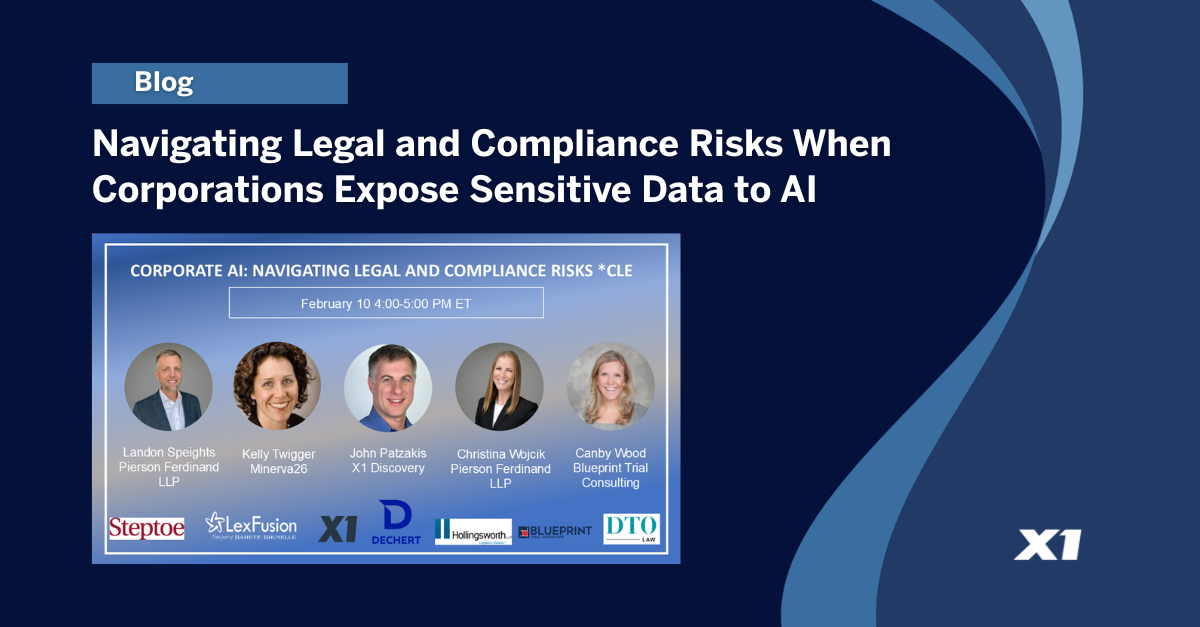
Navigating Legal and Compliance Risks When Corporations Expose Sensitive Data to AI

By Kelly Twigger and John Patzakis

Implementing AI within a corporate environment is no longer a matter of “if” but “how.” We recently addressed these challenges in our webinar, “Navigating Legal and Compliance Risks in AI,” where our panel of experts discussed the strategic transition required to build a robust risk mitigation framework. While the efficiency gains of AI—such as automating workflows and surfacing deep insights—are compelling, introducing sensitive enterprise data into these models without a tactical plan can lead to unintended consequences. These risks range from the dilution of trade secrets to complex eDiscovery obligations and substantial regulatory exposure under the GDPR.

To leverage AI safely, counsel should focus on the following grounded strategies for risk management.

Protect Trade Secrets
Under federal law, trade secret status is contingent upon the owner taking “reasonable measures” to maintain secrecy. This is a rigorous standard; if proprietary information—such as source code or high-value technical data—is fed into an unsecured AI model without strict access controls, a company risks losing its legal protections entirely.

  • Review the Judicial Standard: In Snyder v. Beam Technologies, Inc., the 10th Circuit affirmed that failing to use confidentiality protections or allowing information to reside on unsecured devices can defeat trade secret status.
  • Maintain Active Safeguards: Courts emphasize that consistent and active safeguards are required to maintain secrecy. Lax internal controls during AI interactions can be cited as evidence that “reasonable measures” were not maintained.
  • Implement No-Prompt Zones: Establish “No-Prompt Zones” for your organization’s most sensitive intellectual property. By isolating core IP from third-party cloud models, you maintain a defensible record of “reasonable measures” that can withstand scrutiny in litigation.

Manage the eDiscovery Paper Trail
AI interactions—both the prompts submitted by employees and the responses generated by the tools—are considered discoverable Electronically Stored Information (ESI). These records are part of the corporate record and are subject to subpoena and legal holds.

  • Understand the Technical Reality: Microsoft has confirmed that Microsoft 365 Copilot interactions are logged through the Purview unified audit log, making them searchable, preservable, and producible via eDiscovery tools.
  • Assess Scope of Exposure: Because these chats are treated no differently than emails, they may inadvertently expose privileged or damaging material if not managed properly.
  • Map Information Logs: Update your legal hold workflows to specifically include AI conversation logs and audit trails. Mapping where these logs live before litigation arises ensures a more controlled and cost-effective discovery process.

Navigate GDPR and Data Privacy
Processing customer or employee data through AI models requires strict adherence to the GDPR principles of data minimization, purpose limitation, and lawfulness. Feeding sensitive data into AI models without a clearly articulated lawful basis—such as consent or legitimate interest—can result in significant administrative fines.

  • Meet Compliance Requirements: European authorities require organizations to demonstrate compliance by documenting purposes, limiting data inputs, and ensuring appropriate safeguards are in place.
  • Identify Special Categories: The GDPR is particularly restrictive regarding health information or data revealing racial or ethnic origin, requiring specific exemptions for processing.
  • Conduct Privacy Impact Assessments: Perform mandatory Privacy Impact Assessments (PIAs) for any AI tool that touches personal data. Documenting the purpose and necessity of the processing is critical for maintaining regulatory standing during an audit.

Leverage In-Place AI Functionality
A critical strategy for reducing risk is shifting where the AI processing occurs. Rather than routing data through external, third-party cloud-hosted AI services, organizations should consider prioritizing workflows where AI is applied in-place within the corporate network or controlled enterprise environment.

  • Secure the Data Perimeter: By keeping data and AI processing behind the organization’s own security firewall, you materially reduce the risk of trade secret leakage and data exfiltration.
  • Minimize Third-Party Footprint: Applying AI in-place narrows the scope of discoverable third-party records, as the interactions remain within your internal infrastructure rather than residing on a vendor’s servers.
  • Establish Full Governance Control: This model provides counsel with direct control over privacy, retention, and audit obligations—essentially giving you the “kill switch” for data that you simply do not have with external cloud vendors.

Tactical Governance and Ethical Oversight
Counsel must navigate the professional and technical nuances of AI deployment to ensure long-term stability.

  • Ensure Professional Competence: The ethical duty of technological competence requires attorneys to understand the limitations of the tools they use. AI should be treated as a “junior associate”—capable of great speed but requiring diligent human verification of all output.
  • Apply Risk-Based Tiering: Not all AI use cases carry the same weight. We recommend a tiered approach:
    o Tier 1 (Administrative): Low-risk tasks involving non-sensitive data.
    o Tier 2 (Internal/Marketing): Standard communications requiring routine oversight.
    o Tier 3 (High-Value/Restricted): High-stakes processing involving PII, health data, or proprietary IP, requiring senior legal sign-off and strict data handling protocols.
  • Execute Proactive Vendor Vetting: Move from consumer-grade tools to enterprise solutions that offer SOC 2 Type 2 attestations. Ensure contracts explicitly prohibit the vendor from using your data to train their global models.

In light of these risks, corporate counsel should take a proactive, structured approach to AI governance. This includes implementing data classification and usage controls to prevent sensitive trade secrets from being exposed to AI systems without safeguards; establishing clear policies governing AI prompts, outputs, retention, and eDiscovery treatment; and conducting privacy impact assessments to ensure personal data processing complies with GDPR and similar regulations. In addition, counsel should carefully evaluate AI deployment models and consider workflows in which AI models are deployed in-place within the corporate network or controlled enterprise environment, rather than routed through third-party cloud-hosted AI services. Keeping data and AI processing inside the organization’s security perimeter can materially reduce trade secret leakage risk, narrow the scope of discoverable third-party records, and provide greater control over privacy, retention, and audit obligations—while still allowing the enterprise to realize the benefits of advanced AI capabilities.

For a deeper dive into these strategies and more case studies, you can watch the full session here.

1 Comment

Filed under Best Practices, compliance, Corporations, Cybersecurity, Data Governance, ECA, eDiscovery & Compliance, Enterprise AI, Enterprise eDiscovery, ESI, GDPR, Information Governance, Records Management