
Tag Archives: Innovation

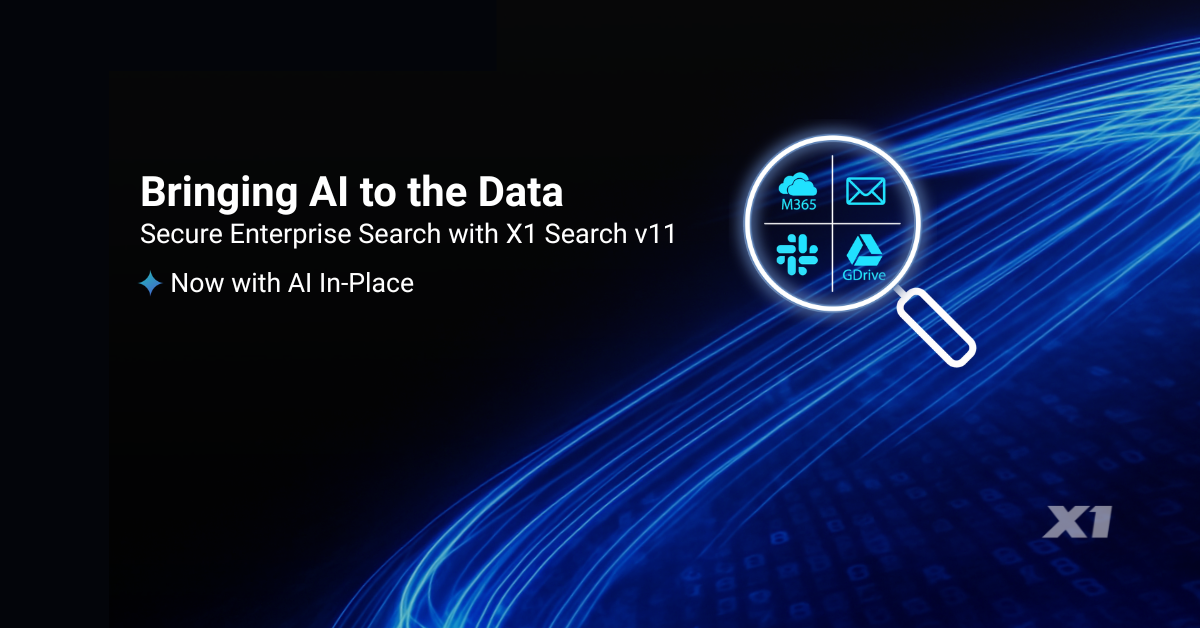
Bringing AI to the Data: How X1 Search v11 Redefines Secure Enterprise Search

By John Patzakis

At X1, we believe the future of enterprise AI depends on a simple but often overlooked principle: data should not have to move in order to become intelligent. With the launch of X1 Search v11, we are introducing a fundamentally different approach—one that embeds AI directly into our index-in-place architecture. Rather than forcing organizations to centralize and copy their data into external platforms, we enable AI to operate exactly where that data already lives. You can read the full press release here: https://www.x1.com/x1-introduces-ai-powered-x1-search-delivering-secure-ai-in-place-for-individual-and-enterprise-users/

This release represents an important milestone for us and for our customers. As Chas Meier noted, “X1 Search v11 marks an important milestone in how organizations can safely apply AI…without compromising the security controls enterprise environments demand.” That statement reflects our core design philosophy: AI must adapt to enterprise security, compliance, and governance requirements—not the other way around.

With X1 Search v11, we are delivering AI capabilities directly within our micro-index. That means organizations can apply advanced intelligence—classification, categorization, and contextual analysis—across emails, files, and collaboration data without ever relocating that information. Everything happens in place, within existing security boundaries, whether on endpoints or across enterprise systems.

For large enterprises, this architecture unlocks an even more powerful capability: the ability to deploy their own trained and curated large language models directly into the X1 index. Instead of relying solely on generic, hosted AI services, organizations can operationalize models tailored to their data that reflect their internal policies, regulatory requirements, and business workflows. These models run directly against their data, in place, delivering highly relevant and controlled outcomes.

This approach stands in sharp contrast to traditional hosted AI platforms. In those models, organizations must copy and transfer massive amounts of sensitive data into third-party hosted AI platforms before any meaningful analysis can occur. That process introduces serious risks. Moving data to outside providers complicates compliance, potentially compromises IP, and creates new attack surfaces that most enterprises simply cannot accept.

Beyond security concerns, the traditional model also breaks down operationally at scale. Enterprises are not dealing with small data sets; they are managing dozens of terabytes of distributed, unstructured data. Attempting to duplicate and transfer that volume is not just costly; it is infeasible. The result is delays, fragmentation, and incomplete analysis—undermining the very promise of AI.

We have taken a different path. By bringing AI to the data through our distributed micro-indexing technology, we eliminate the need for data movement entirely. Models can be deployed directly to where data resides, enabling real-time analysis while preserving security, reducing infrastructure overhead, and scaling seamlessly across the enterprise.

We see X1 Search v11 as more than a product release—it is a shift in how enterprise AI is deployed. Organizations no longer have to choose between innovation and control. With AI in place, they can achieve both.

To see this in action, we invite you to join our upcoming live product tour on Thursday, April 23, providing a guided walkthrough of the new AI-enriched capabilities and flexible model deployment features.


Leave a comment

Filed under Best Practices, Business Productivity Search, Desktop Search, Enterprise AI, Enterprise eDiscovery, Enterprise Search, ESI, Google Workspace, Information Access, Information Management, m365, MS Teams, X1 Search 11

AI Without Data Movement: X1’s Webinar Reveals the Future of Secure Enterprise AI

By John Patzakis

X1’s recent webinar announcing the availability of true “AI in-place” for the enterprise was both highly attended and strongly validated by the audience response. The session did more than introduce a new feature; it articulated a fundamentally different architectural approach to enterprise AI—one designed explicitly for security, compliance, and scalability in complex, distributed environments. Our central message was simple: enterprise AI adoption has been constrained not by lack of interest, but by architectural and security requirements that existing platforms have failed to address.

That reality was most powerfully captured in a quote shared on the opening slide from a Fortune 100 Chief Information Security Officer, which set the tone for the entire discussion:

“Normally AI for infosec and compliance use cases is a non-starter for security reasons, but your workflow and architecture is completely different. This allows us – all behind our firewall — to develop our own models that are trained on our own data and customized to our specific security and compliance use cases and deployed in-place across our enterprise.”

This endorsement crystallized the webinar’s core insight: AI becomes viable for the most sensitive enterprise use cases only when it is deployed where the data already lives, rather than forcing data into external or centralized systems.

The technical foundation that makes this possible is X1’s micro-indexing architecture. Unlike traditional platforms built on centralized, resource-intensive indexing technologies, X1 deploys lightweight, distributed micro-indexes directly at the data source. This allows enterprises to index, search, and now apply AI analysis without mass data movement. As emphasized during the webinar, centralized indexing is not just expensive and slow—it is fundamentally misaligned with how modern enterprise data is distributed across file systems, endpoints, cloud platforms, and collaboration tools.

The session then highlighted how this architectural distinction resolves a long-standing problem in discovery, compliance, and security workflows. Legacy platforms require organizations to collect and centralize data before they can analyze it, introducing delays, high costs, and significant risk exposure. X1 reverses that workflow. By enabling visibility and AI-driven classification before collection, organizations can make informed, targeted decisions—collecting only what is necessary, remediating issues in-place, and dramatically reducing both risk and operational overhead.

The discussion also demystified large language models (LLMs), explaining that while model training is compute-intensive, models themselves are increasingly commoditized and portable. Critically, LLMs require extracted text and metadata— processed from native files—to function. This aligns perfectly with X1’s existing capability, as text and metadata extraction are already integral to our micro-indexing process. AI models can therefore be deployed alongside these indexes, operating in parallel across thousands of data sources with massive scalability.

The conversation then connected this architecture to concrete, high-value use cases. In eDiscovery, AI in-place enables faster early case assessment and proportionality by analyzing data where it resides. In incident response and breach investigations, security teams can immediately scope exposure across distributed systems without waiting months for data exports. For compliance and governance, AI models can continuously identify sensitive data, enforce retention policies, and surface risk conditions that were previously impractical to monitor at scale.

In addition to a live product demo showcasing this new capability, we concluded the webinar with several clarifying points and announcements. First, we emphasized that X1 does not access, monetize, or host customer data. Also, AI in-place is not an experimental add-on but an enhancement to a proven, production-grade platform. And notably, there is no additional licensing cost for the AI capability itself—customers simply deploy models within their own environment. With proof-of-concept testing beginning shortly and production deployments targeted for April 2026, the webinar made clear that AI in-place is not a future vision, but an imminent reality for the enterprise.

You can access a recording of the webinar here, and to learn more about X1 Enterprise, please visit us at X1.com.

Leave a comment

Filed under Best Practices, Corporations, Cybersecurity, Data Audit, Data Governance, ECA, eDiscovery, eDiscovery & Compliance, Enterprise AI, Enterprise eDiscovery, ESI, Information Governance