
By John Patzakis
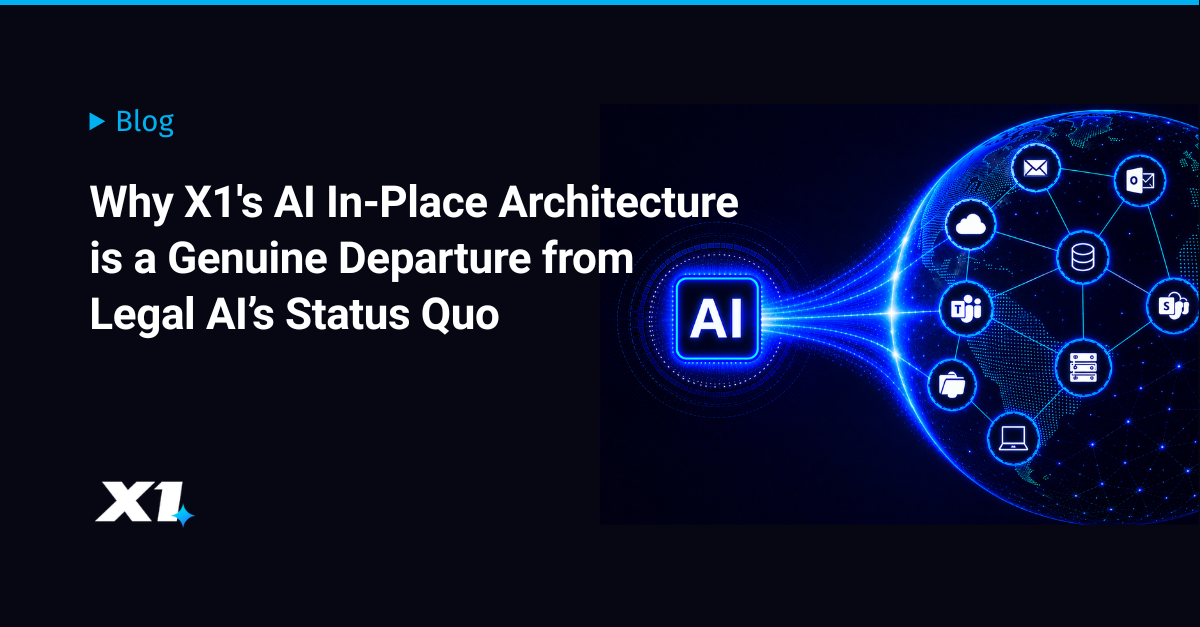
The legal technology market has a buzzword problem. Terms like “AI-powered,” “intelligent review,” and “automated analysis” have been applied so broadly—and so inconsistently—that they have largely lost their ability to signal anything meaningful about how a product actually works. Against that backdrop, X1’s announcement last week of AI In-Place for X1 Enterprise represents a genuinely different approach to applying AI within enterprise legal and compliance workflows. The reason for this basis is X1’s unique architecture.
To understand why, it helps to start with the dominant model that most legal AI tools share. The overwhelming majority of AI-enabled eDiscovery and governance platforms are built on a collect-first assumption: data must be moved out of its native environment—copied, ingested, centralized in a vendor-controlled repository—before any AI model can be applied to it. This is not an incidental design choice; it reflects the fundamental architecture of how most of these platforms were built, long before AI became part of the product story. The result is what practitioners have come to call the “prompt wrapper” problem: an AI interface sits in front of a conventional data pipeline, and the underlying mechanics—the cost, the risk, the latency—remain largely unchanged. A large language model with a “middleware” workflow does not solve the structural problem of what happens to sensitive data before the AI touches it.
X1’s AI In-Place architecture inverts that assumption. Rather than requiring data to travel to an AI system, X1’s patented distributed micro-indexing technology deploys AI models directly into lightweight micro-indexes at the data source itself—across Microsoft 365 environments, file shares, cloud repositories, and endpoints. The AI executes where the data lives, and the data does not move. The implications run across multiple dimensions: data never leaves the enterprise perimeter, security policies and endpoint controls remain intact throughout the process, and the computational overhead and massive AI token costs associated with large-scale data ingestion is avoided entirely. For matters involving a terabyte of data or more—where centralized collection is not merely expensive but operationally infeasible—this architectural distinction is not incremental. It changes what is actually possible.
The workflow mechanics reinforce the point. AI models are deployed into X1’s distributed micro-indexes behind the firewall, execute against enterprise data in place, and surface AI-enriched insights—tags, classifications, risk scores—into a central console without the underlying data ever being collected or copied. That means targeted collection decisions, early case assessment, and information governance actions can be driven by AI-informed analysis conducted across the full enterprise data landscape, not just against a subset of data that has already been moved. The distinction matters because the scope of analysis in the collect-first model is constrained by collection costs; in the in-place model, analysis scope is no longer tethered to collection volume. Investigations and governance programs can, in principle, cast a much wider net analytically while actually reducing the volume of data that requires review.
Mandi Ross, CEO of Insight Optix, offered a perspective that cuts to the core of what makes this architecture commercially significant: “Enabling AI directly where the clients’ data resides fundamentally changes the economics, speed, and risk profile of enterprise data discovery, investigations and compliance workflows. With X1 Enterprise AI In-Place, we can deploy AI models, pre-trained or customized for specific matters, data queries, or compliance requirements—securely within client environments, dramatically accelerating time to insight without sensitive information being collected, duplicated, or centralized outside their control.”
Ross identifies three dimensions the in-place approach changes: economics, speed, and risk. On economics, a significant lever is the reduction in review population size—AI-informed pre-collection filtering means fewer documents proceed to human review. Additionally, costs associated with collection and processing, including expensive AI token utilization, are all but eliminated. On speed, running analysis in situ, without waiting for collection and ingestion cycles, compresses time to first insight—critical in time-sensitive investigations and regulatory responses. On risk, data that does not move cannot be breached in transit, does not reside in vendor infrastructure outside the client’s control, and does not generate the compliance exposure of large-scale cross-boundary transfers. Her comment reflects what experienced practitioners understand but marketing language tends to obscure: the most consequential question about any legal AI tool is not what the AI does, but what happens to the data before and during its operation.
The enterprise deployment model reflects design discipline that distinguishes AI In-Place from retrofitted solutions. Organizations retain centralized governance over AI usage while processing remains local under existing security policies and endpoint controls. AI capabilities are fully optional and configurable at the data source level—important for organizations operating across multiple jurisdictions with differing regulatory requirements—and customer data is never used to train, fine-tune, or enrich underlying AI models, addressing a standard due diligence concern in enterprise AI procurement.
The practical use case implications are significant across several domains. In legal and eDiscovery contexts, in-place TAR and pre-collection analytics allow AI-informed decisions about what to collect before collection begins, directly reducing review volumes and costs. In information governance, AI-driven classification and policy enforcement can operate continuously across the full enterprise data estate rather than against periodic snapshots, enabling more responsive and defensible governance programs. In security and investigations, real-time insider risk detection at petabyte scale—across endpoint and cloud environments simultaneously—becomes feasible where centralized architectures make it impractical. In each case, analytical scope is no longer constrained by collection logistics.
Most legal AI products apply AI to data after it has already moved through the conventional collection pipeline. AI In-Place asks a more fundamental question: whether the pipeline itself should be reconceived. We will demonstrate it live on Wednesday, June 24—for those evaluating enterprise AI in legal, compliance, or governance contexts, it is worth seeing what a genuinely different architecture looks like in practice.