
Tag Archives: AI In-Place

Navigating Legal and Compliance Risks When Corporations Expose Sensitive Data to AI

By Kelly Twigger and John Patzakis
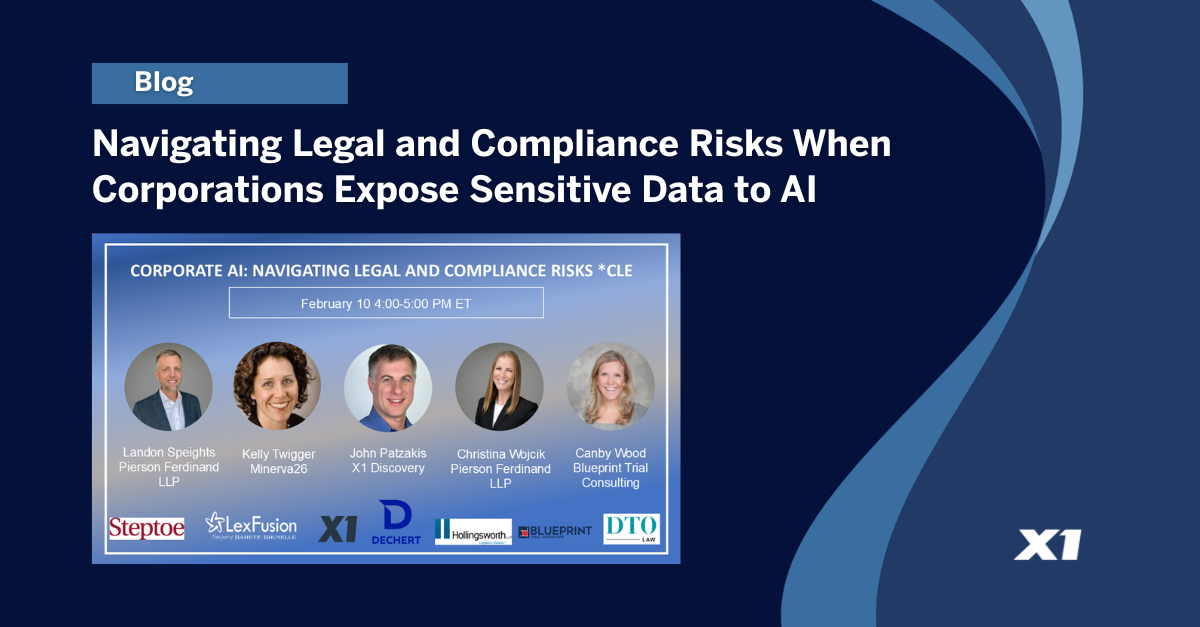
Implementing AI within a corporate environment is no longer a matter of “if” but “how.” We recently addressed these challenges in our webinar, “Navigating Legal and Compliance Risks in AI,” where our panel of experts discussed the strategic transition required to build a robust risk mitigation framework. While the efficiency gains of AI—such as automating workflows and surfacing deep insights—are compelling, introducing sensitive enterprise data into these models without a tactical plan can lead to unintended consequences. These risks range from the dilution of trade secrets to complex eDiscovery obligations and substantial regulatory exposure under the GDPR.

To leverage AI safely, counsel should focus on the following grounded strategies for risk management.

Protect Trade Secrets
Under federal law, trade secret status is contingent upon the owner taking “reasonable measures” to maintain secrecy. This is a rigorous standard; if proprietary information—such as source code or high-value technical data—is fed into an unsecured AI model without strict access controls, a company risks losing its legal protections entirely.

  • Review the Judicial Standard: In Snyder v. Beam Technologies, Inc., the 10th Circuit affirmed that failing to use confidentiality protections or allowing information to reside on unsecured devices can defeat trade secret status.
  • Maintain Active Safeguards: Courts emphasize that consistent and active safeguards are required to maintain secrecy. Lax internal controls during AI interactions can be cited as evidence that “reasonable measures” were not maintained.
  • Implement No-Prompt Zones: Establish “No-Prompt Zones” for your organization’s most sensitive intellectual property. By isolating core IP from third-party cloud models, you maintain a defensible record of “reasonable measures” that can withstand scrutiny in litigation.

Manage the eDiscovery Paper Trail
AI interactions—both the prompts submitted by employees and the responses generated by the tools—are considered discoverable Electronically Stored Information (ESI). These records are part of the corporate record and are subject to subpoena and legal holds.

  • Understand the Technical Reality: Microsoft has confirmed that Microsoft 365 Copilot interactions are logged through the Purview unified audit log, making them searchable, preservable, and producible via eDiscovery tools.
  • Assess Scope of Exposure: Because these chats are treated no differently than emails, they may inadvertently expose privileged or damaging material if not managed properly.
  • Map Information Logs: Update your legal hold workflows to specifically include AI conversation logs and audit trails. Mapping where these logs live before litigation arises ensures a more controlled and cost-effective discovery process.

Navigate GDPR and Data Privacy
Processing customer or employee data through AI models requires strict adherence to the GDPR principles of data minimization, purpose limitation, and lawfulness. Feeding sensitive data into AI models without a clearly articulated lawful basis—such as consent or legitimate interest—can result in significant administrative fines.

  • Meet Compliance Requirements: European authorities require organizations to demonstrate compliance by documenting purposes, limiting data inputs, and ensuring appropriate safeguards are in place.
  • Identify Special Categories: The GDPR is particularly restrictive regarding health information or data revealing racial or ethnic origin, requiring specific exemptions for processing.
  • Conduct Privacy Impact Assessments: Perform mandatory Privacy Impact Assessments (PIAs) for any AI tool that touches personal data. Documenting the purpose and necessity of the processing is critical for maintaining regulatory standing during an audit.

Leverage In-Place AI Functionality
A critical strategy for reducing risk is shifting where the AI processing occurs. Rather than routing data through external, third-party cloud-hosted AI services, organizations should consider prioritizing workflows where AI is applied in-place within the corporate network or controlled enterprise environment.

  • Secure the Data Perimeter: By keeping data and AI processing behind the organization’s own security firewall, you materially reduce the risk of trade secret leakage and data exfiltration.
  • Minimize Third-Party Footprint: Applying AI in-place narrows the scope of discoverable third-party records, as the interactions remain within your internal infrastructure rather than residing on a vendor’s servers.
  • Establish Full Governance Control: This model provides counsel with direct control over privacy, retention, and audit obligations—essentially giving you the “kill switch” for data that you simply do not have with external cloud vendors.

Tactical Governance and Ethical Oversight
Counsel must navigate the professional and technical nuances of AI deployment to ensure long-term stability.

  • Ensure Professional Competence: The ethical duty of technological competence requires attorneys to understand the limitations of the tools they use. AI should be treated as a “junior associate”—capable of great speed but requiring diligent human verification of all output.
  • Apply Risk-Based Tiering: Not all AI use cases carry the same weight. We recommend a tiered approach:
    o Tier 1 (Administrative): Low-risk tasks involving non-sensitive data.
    o Tier 2 (Internal/Marketing): Standard communications requiring routine oversight.
    o Tier 3 (High-Value/Restricted): High-stakes processing involving PII, health data, or proprietary IP, requiring senior legal sign-off and strict data handling protocols.
  • Execute Proactive Vendor Vetting: Move from consumer-grade tools to enterprise solutions that offer SOC 2 Type 2 attestations. Ensure contracts explicitly prohibit the vendor from using your data to train their global models.

In light of these risks, corporate counsel should take a proactive, structured approach to AI governance. This includes implementing data classification and usage controls to prevent sensitive trade secrets from being exposed to AI systems without safeguards; establishing clear policies governing AI prompts, outputs, retention, and eDiscovery treatment; and conducting privacy impact assessments to ensure personal data processing complies with GDPR and similar regulations. In addition, counsel should carefully evaluate AI deployment models and consider workflows in which AI models are deployed in-place within the corporate network or controlled enterprise environment, rather than routed through third-party cloud-hosted AI services. Keeping data and AI processing inside the organization’s security perimeter can materially reduce trade secret leakage risk, narrow the scope of discoverable third-party records, and provide greater control over privacy, retention, and audit obligations—while still allowing the enterprise to realize the benefits of advanced AI capabilities.

For a deeper dive into these strategies and more case studies, you can watch the full session here.
Leave a comment

Filed under Best Practices, compliance, Corporations, Cybersecurity, Data Governance, ECA, eDiscovery & Compliance, Enterprise AI, Enterprise eDiscovery, ESI, GDPR, Information Governance, Records Management

AI Without Data Movement: X1’s Webinar Reveals the Future of Secure Enterprise AI

By John Patzakis

X1’s recent webinar announcing the availability of true “AI in-place” for the enterprise was both highly attended and strongly validated by the audience response. The session did more than introduce a new feature; it articulated a fundamentally different architectural approach to enterprise AI—one designed explicitly for security, compliance, and scalability in complex, distributed environments. Our central message was simple: enterprise AI adoption has been constrained not by lack of interest, but by architectural and security requirements that existing platforms have failed to address.

That reality was most powerfully captured in a quote shared on the opening slide from a Fortune 100 Chief Information Security Officer, which set the tone for the entire discussion:

“Normally AI for infosec and compliance use cases is a non-starter for security reasons, but your workflow and architecture is completely different. This allows us – all behind our firewall — to develop our own models that are trained on our own data and customized to our specific security and compliance use cases and deployed in-place across our enterprise.”

This endorsement crystallized the webinar’s core insight: AI becomes viable for the most sensitive enterprise use cases only when it is deployed where the data already lives, rather than forcing data into external or centralized systems.

The technical foundation that makes this possible is X1’s micro-indexing architecture. Unlike traditional platforms built on centralized, resource-intensive indexing technologies, X1 deploys lightweight, distributed micro-indexes directly at the data source. This allows enterprises to index, search, and now apply AI analysis without mass data movement. As emphasized during the webinar, centralized indexing is not just expensive and slow—it is fundamentally misaligned with how modern enterprise data is distributed across file systems, endpoints, cloud platforms, and collaboration tools.

The session then highlighted how this architectural distinction resolves a long-standing problem in discovery, compliance, and security workflows. Legacy platforms require organizations to collect and centralize data before they can analyze it, introducing delays, high costs, and significant risk exposure. X1 reverses that workflow. By enabling visibility and AI-driven classification before collection, organizations can make informed, targeted decisions—collecting only what is necessary, remediating issues in-place, and dramatically reducing both risk and operational overhead.

The discussion also demystified large language models (LLMs), explaining that while model training is compute-intensive, models themselves are increasingly commoditized and portable. Critically, LLMs require extracted text and metadata— processed from native files—to function. This aligns perfectly with X1’s existing capability, as text and metadata extraction are already integral to our micro-indexing process. AI models can therefore be deployed alongside these indexes, operating in parallel across thousands of data sources with massive scalability.

The conversation then connected this architecture to concrete, high-value use cases. In eDiscovery, AI in-place enables faster early case assessment and proportionality by analyzing data where it resides. In incident response and breach investigations, security teams can immediately scope exposure across distributed systems without waiting months for data exports. For compliance and governance, AI models can continuously identify sensitive data, enforce retention policies, and surface risk conditions that were previously impractical to monitor at scale.

In addition to a live product demo showcasing this new capability, we concluded the webinar with several clarifying points and announcements. First, we emphasized that X1 does not access, monetize, or host customer data. Also, AI in-place is not an experimental add-on but an enhancement to a proven, production-grade platform. And notably, there is no additional licensing cost for the AI capability itself—customers simply deploy models within their own environment. With proof-of-concept testing beginning shortly and production deployments targeted for April 2026, the webinar made clear that AI in-place is not a future vision, but an imminent reality for the enterprise.

You can access a recording of the webinar here, and to learn more about X1 Enterprise, please visit us at X1.com.

Leave a comment

Filed under Best Practices, Corporations, Cybersecurity, Data Audit, Data Governance, ECA, eDiscovery, eDiscovery & Compliance, Enterprise AI, Enterprise eDiscovery, ESI, Information Governance

X1 Brings “AI In-Place” to the Enterprise—A Major Breakthrough for Secure, Scalable AI Deployment

By John Patzakis

Our latest announcement represents a true inflection point in enterprise AI. With X1 Enterprise’s newly introduced capability for AI in-place, organizations and their service providers will, for the first time, be able to deploy and execute large language models (LLMs) directly where enterprise data lives—without moving or copying that data.

This is more than a product enhancement; it is a fundamental shift in how AI is applied across the enterprise.

The Foundation: Efficient Text Extraction Is Critical for AI
Large language models (LLMs) are the core engines that power today’s AI revolution. These models rely entirely on textual input to perform reasoning, summarization, search, and analysis. That is why text extraction is the critical first step. LLMs can only operate once another process extracts the text from emails, documents and chats. Traditionally, that meant copying or exporting data to external systems hosted by third party vendors, a process fraught with risk, cost, and compliance challenges.

Solving the “Data Movement Problem” for Enterprise AI
So, the key barrier to enterprise AI adoption has been the reluctance to move sensitive corporate data to external AI platforms. Whether for security, governance or cost reasons, most enterprises simply cannot send their data outside their environment.

X1’s innovation solves that problem head-on. Instead of shipping sensitive data out to an AI system, X1 brings the AI to the data. Enterprises can now deploy their own proprietary models or open-source LLMs within the secure perimeter of their existing infrastructure, whether on premises or in the cloud. X1’s index-in-place architecture performs the text extraction and indexing where the data resides. By extending that same principle to AI—forward-deploying LLMs directly to enterprise data sources—X1 now enables AI in-place. The result: organizations can apply the analytical power of LLMs across their data without ever moving it.

Once the LLMs are deployed into the X1 micro-indexes, X1 will then auto-apply AI-informed tags, which a user can query globally from a central console and act upon through targeted data collection or remediation. Imagine petabytes of data on file servers, laptops M365 and other sources all AI-classified and then queried and collected on a highly targeted basis.

This means enterprises can now unlock powerful new use cases no matter the scale—AI-assisted compliance, risk monitoring, GRC audits, eDiscovery, and more—while maintaining full control of their data and eliminating the need for costly, risky data transfers.

Enabling Collaboration Between Enterprises and Their Advisors
William Belt, Managing Director and Consulting Practice Leader at Complete Discovery Source, described the impact succinctly:

“Enabling AI in-place where our corporate client’s data lives is game-changing. We look forward to working with our clients to deploy AI models that are either pre-trained or customized for a specific matter or compliance requirement utilizing the X1 Enterprise platform.”

This capability creates a new bridge between corporations and their professional advisors—consulting firms, law firms, and service providers—who can now collaborate directly with their clients to develop, fine-tune, and deploy customized AI models for specific business or legal needs.

Rather than relying on generic cloud-based AI tools, organizations can now build targeted, matter-specific LLMs that are tuned to their unique data and compliance requirements, all executed securely in-place through the X1 Enterprise Platform.

A New Era for Enterprise AI
With this release, X1 is redefining the architecture of enterprise AI. Its ability to perform distributed micro-indexing and in-place AI analysis across global data sources enables secure, scalable, and cost-effective intelligence—without ever duplicating or relocating sensitive data.

For enterprises and their partners, this represents a new era of possibility: true AI at enterprise scale, in-place.

X1 will host a webinar on Wednesday, December 10, featuring a detailed overview of this new capability and a live demonstration. You can register here.

Leave a comment

Filed under Cloud Data, Corporations, Cybersecurity, eDiscovery, eDiscovery & Compliance, Enterprise AI, Enterprise eDiscovery, Information Governance, m365