Social Media Evidence at the Center of the A-Rod Suspension

Earlier this month, Major League Baseball took the unprecedented step of suspending a star player, Alex Rodriguez, for two years due alleged illegal use of performance enhancing drugs (PEDs). Yankee playerWhile the suspension of one of baseball’s greatest players of all time made the headlines, the critical role social media evidence played in tying “A-Rod” to Biogenesis, the company which allegedly provided him with the PEDs, is an important sub-story. While we are not at liberty to discuss any details of the social media investigation software used by any of the parties, this Associated Press report describes a detailed, thorough and highly professional investigation of the social media evidence involved.

Specifically, investigators collected key evidence from publically available Facebook posts and Tweets from associates of the targets, which apparently proved to be the most effective source of evidence. Per the AP: “Baseball investigators examined the Facebook pages of (Biogenesis founder Anthony) Bosch and Porter Fisher, the former Biogenesis associate who gave documents to the newspaper. They began to sketch out which people they were friends with, and which of those friends posted photos of athletes or mentioned athletes. Each link led to new loops that provided leads.”

In response to the investigation, MLB players’ union general counsel David Prouty noted that social media evidence “adds a layer of proof that certainly wasn’t available many years ago.”

This type of thorough investigation of publically available social media evidence is only possible with best practices technology that enables scalable and automated collection of up to millions of items preserved and organized in a single case in an instantly searchable and reviewable format.

Given its very high profile and the high stakes involved (The suspension could cost A-Rod over $100 million) the A-Rod case represents a seminal development in the field of social media and Internet investigations. According to the media reports, this is not a situation where social media evidence merely served a supporting role, but was a difference-maker that apparently formed the basis of the suspension.

No need to comment further.

1 Comment

Filed under Best Practices, Social Media Investigations

Zimmerman Prosecutors Also Missed Key Website Evidence

As an epilogue to our recent post identifying various relevant social media evidence missed by prosecutors in the State of Florida vs. George Zimmerman prosecution, another instructive moment illustrated the importance of general website evidence and why many of our law firm clients tell us they capture website evidence on a daily basis. I’ll have more on that second point later.

Zimmerman’s lawyers called Mixed Martial Arts (MMA) trainer Adam Pollock, who trained George Zimmerman at his Florida gym from October of 2010 until “the end of 2011″— about two months before the shooting of Trayvon Martin. The defense, with apparent success, cited Pollock’s testimony to establish that the former neighborhood watch volunteer was an unaccomplished fighter and ineffective at self-defense. “He was an overweight, large man when he came to us, a very pleasant, very nice man, but physically soft – predominantly fat,” Pollock testified. “Not a lot of muscle. Not a lot of strength.” “He was about a 1,” said Pollock, when asked to rank Zimmerman’s athletic skill on a scale of 1 to 10.

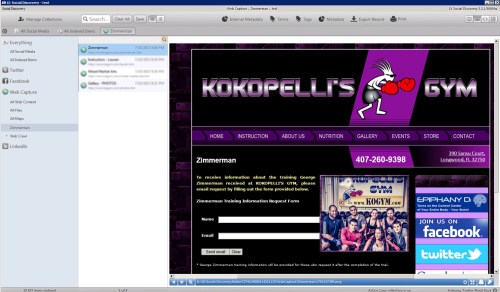
It turns out however, that Pollock’s gym prominently and proudly advertised George Zimmerman as their client, offering information about obtaining the same self-defense training he received:

Zimmerman 2Click image to enlarge

This evidence, which was captured by X1 Social Discovery, would suggest bias and arguably contradicts Zimmerman’s lawyers assertion that he lacked self-defense prowess. The prosecution did not have this information available on cross-examination and, apparently learning of it at a later time, tried to re-call Pollock as a rebuttal witness. However, the court sustained the defenses’ objection on procedural grounds, noting that the State should have raised the issue on cross-examination. Also, as a side note, this web page had been deleted by then.

This is just one illustration as to why our larger law firm clients tell us they employ X1 Social Discovery on a daily — sometimes hourly — basis, as website evidence factors prominently into many types of legal matters. Witnesses often maintain personal websites or are employed by a company with a large website that often harbors bits of key information buried in the recesses of the site, yet are publicly available.

As such, all available website evidence associated with parties and witnesses should be preserved when their identities become known. Due diligence for mergers and acquisition and other securities matters, compliance monitoring, and discovery related to business disputes and intellectual property are other use cases that require extensive capture analysis of website data.

But only best practices technology that provides a scalable, automated, defensible and cost-effective capability enables website collections to be performed on a routine and standard basis. Simple screen captures are not defensible, do not scale as they only allow very limited coverage of an entire site, do not collect source page data (which often presents key evidence) and do not allow for instant search of the collected data, which is essential for a scalable and effective process. With tools like X1 Social Discovery, website data can be collected either on a single web capture or by crawling an entire site consisting of thousands of pages. Additionally, the data is instantly searchable and subject to litigation review process with filtering, intuitive first pass review, tagging, and finally export to attorney review platforms for tertiary review and production.

As with the case of other forms of electronic evidence collection, the compelling legal requirement exists long before scalable, automated and cost-effective technical solutions are developed. Now that such tools are available, we are seeing more and more legal professionals bake-in website evidence capture, along with social media, into their routine discovery processes.

Leave a comment

Filed under Uncategorized

Highlights from Amazon’s Cloud eDiscovery and Search Webinar

Recently, Amazon Web Services (AWS) hosted a first of its kind webinar by a major cloud provider addressing the topics of eDiscovery and enterprise search. The webinar showcased solutions that allow organizations to quickly search, identify and act upon distributed data, whether it resides within the enterprise or within the AWS cloud. Vikram Garlapati, an Amazon Web Service Solutions Architect, lead off the discussion.

LTech CIO Eric Klotzko also presented. LTech is a cloud systems integrator and AWS partner supporting implementations of next-generation enterprise search and eDiscovery solutions that install and operate in virtual environments.Amazon Web Services2

Here are some of key highlights and takeaways:

Vikram Garlapati outlined the key benefits of the cloud, including the provisioning of resources on demand as needed as opposed to incurring large capital outlays that must meet organizations’ estimated requirements over a multi-year period. This applies to enterprise software as well, where cloud-enabled eDiscovery software can be provisioned on a monthly, weekly or even daily basis as needed.
The webinar featured a discussion featuring a compare and contrast between AWS’s Cloud Search and X1 Rapid Discovery. The presenters described AWS Cloud Search as a SaaS search engine geared toward the search of websites and static databases. Cloud Search is a solution popular with many developers in specific use cases. X1 Rapid Discovery operates in both a SaaS or IaaS (within the customers cloud instance) environment with an extensive feature set and an intuitive user interface. Vikram Garlapati stated that X1 supports “more of an enterprise scenario.”
Eric Klotzo underscored the limitations of traditional enterprise search solutions that are hardware appliance-based or require an extensive manual on-site install process, thereby rendering such solutions as non-starters for deploying into and operating within virtualized cloud deployments.
Eric also emphasized the importance of supporting hybrid cloud deployments as most cloud adoption involves an often long transitory period: “X1 can install into both the cloud and traditional on-premise locations, providing consolidated access to your data from a single pane of glass, which is very compelling.”

A recording of the AWS webinar is available here >


Leave a comment

Filed under Cloud Data, eDiscovery & Compliance, Enterprise eDiscovery, IaaS, Information Management, Preservation & Collection, Uncategorized, Virtualized Environment

Zimmerman Trial Counsel Botches Social Media Evidence on National TV

If you are trial counsel presenting, for example, DNA or scientific accident reconstruction evidence, you would be sure to have a good command of such evidence. Not that a PhD in such subjects is required, but a competent understanding from at least a layman’s perspective would enable an effective direct or cross-examination. Nothing more than basic trial preparation.

Unfortunately, the prosecution in the Zimmerman trial did not meet this standard. Yesterday, while questioning key witness Jenna Lauer, prosecutor Bernie de la Rionda lugged his laptop up to the witness stand and clumsily poked around Lauer‘s Twitter account. He sought to paint Lauer as a Twitter follower of Robert Zimmerman, the defendant‘s brother, thus suggesting bias. Unfortunately, de la Rionda lacked a general command of how Twitter worked, including a basic understanding of a follower versus a followee on Twitter, and Lauer was able to get away with denying she was following Robert Zimmerman. (Video of this trial exchange here – at the 8:20 mark).

In truth, Lauer was in fact following Robert Zimmerman and, in an apparent recognition that she may have committed perjury, deleted her Twitter account shortly after her testimony. Below is a screenshot establishing who Lauer was following, obtained from the silent follow feature of X1 Social Discovery, which collected and preserved all tweets and other publically available account information only hours before Lauer deleted the account from Twitter. This evidence clearly reflects that George Zimmerman’s brother was in fact followed by the witness.

Click to enlarge image

Click to enlarge image

By now it should be obvious to every trial lawyer that utilizing best practice tools that not only collect and preserve this key social media evidence in a silent and defensible manner but also enable the presentation of such key social media evidence at trial — without having to share your laptop with the witness out of the view of the jury — is required. As attorney John Browning, a partner at Lewis Brisbois, pointed out earlier on this blog, any attorney who does not leverage the mountains of social media evidence available in nearly all cases may be violating their ethical duty of competence.

I don’t know what the local rules are for the Zimmerman courtroom, but the above screenshot from X1 Social Discovery would have made an effective visual. Evidence on social media accounts establishing that a party or witness has friended or is following a particular party is routinely used to establish bias establish connections to our knowledge of that person or subject matter. There are mountains of clues and subtle inferences that can be derived from such information with the right tools and requisite degree of understanding of social media, and the attorneys and investigators who have the competency to leverage this information gain the upper hand.

And as it turns out, social media evidence is relevant to the testimony of the two most important witnesses in the Zimmerman case thus far. Travon Martin’s friend and “star” prosecution witness Rachel Jeantel apparently deleted portions of her twitter account in the past few days to allegedly cover-up incriminating and off color tweets. The lesson here is that social media evidence is not only relevant to the direct parties to a litigation but also key witnesses as well as jurors.

1 Comment

Filed under Best Practices, Case Law, Social Media Investigations