
By Chas Meier, CPO at X1
Last week I ran an experiment I’d encourage every organization that has deployed Claude to repeat. I gave Claude the same request twice: “Find the most recent signed NDA I received by email and summarize its key terms.” The first time, Claude had the X1 Search MCP connector. The second time, I told it to work the way most AI deployments work today: by iterating over the data source through cloud APIs.
Both runs produced the same correct answer: the NDA that hit my inbox in August, with its two-year term, its data-protection clause, its arbitration provisions, and its signature date. Same model, same question, same answer.
Everything else about the two runs was different. On one laptop, the difference is a curiosity. Across every Claude seat in your organization, it decides how much data leaves your endpoints, how much of your token spend produces answers, and whether your quotas last the month.
The task looks trivial. It isn’t.
“Find the signed NDA” is the kind of request knowledge workers make of an assistant fifty times a week. But notice where the answer actually lives: inside a 535 KB PDF attachment, buried in an email thread, in a mailbox with tens of thousands of messages. That’s not a corner case. That’s where enterprise answers live: in attachments, in files, in the documents behind the metadata.
And that’s precisely where the standard approach falls apart.
Run one: Claude with X1 Search
With X1, the whole exchange took two tool calls. Claude asked the local index for recent mail matching “signed NDA” with a PDF attachment, newest first, and got back three result rows: subject, sender, date, filename. It then asked for the content of the top attachment and received the NDA’s pre-extracted plain text. Total: about 3,400 tokens, roughly 1.7% of a 200K-token context window. Each call returned in well under half a second, because the search ran on-device against an index that had already done the work.
What reached the model: three search-result rows and one document’s text. In other words, the answer’s raw material and nothing else.
Run two: Claude iterating the data source
Without X1, Claude did what every agent without a search layer does: it foraged. The email search returned twenty-five messages’ worth of metadata and body snippets, with a “more results” flag inviting another page. Those snippets weren’t confined to the NDA. They included fragments of unrelated customer matters, active deals, and partner negotiations, because that’s what a keyword search over a working mailbox returns. Claude then read the entire candidate email, a five-message forwarded thread carrying external contacts, mobile numbers, and signature blocks, and finally fetched the attachment.
Total: about 11,800 tokens and three-plus round trips to reach the identical answer. Three and a half times the cost, and a dramatically wider blast radius of data through a cloud API into model context.
Here’s the uncomfortable part: that was the favorable version of the baseline. My test used a curated Microsoft 365 connector that extracts attachment text server-side. A generic agent hitting the Graph API directly gets that PDF as base64, and 535 KB of base64 is roughly 178,000 tokens in a single response. That’s 89% of a 200K context window consumed by one file, before the model has read a word of it. A 3 MB PowerPoint doesn’t fit at all: as base64 it’s over a million tokens. X1 returns a one-line local path instead.
Side by side: same question, same answer
| Claude + X1 Search | Claude + cloud connector (best case) | Claude + raw Graph API (computed) | |
| Where search runs | On-device, against a local index | Cloud API | Cloud API |
| Round trips | 2 | 3+ | 3+ |
| Tokens used | ~3,400 | ~11,800 | ~178,000 for the PDF alone |
| Share of a 200K context window | 1.7% | ~6% | 89%+ |
| Data sent to the model | 3 result rows + 1 document’s text | 25 emails’ snippets, a full 5-message thread, and the attachment | All of that, plus the file as base64 |
| Relative token cost | 1x | ~3.5x | ~55x |
What the difference adds up to
Two round trips instead of an open-ended foraging loop. Three result rows and one document instead of twenty-five emails and a full thread, and none of your unrelated customer, deal, or contact data in model context. About 3,400 tokens instead of 11,800, or 178,000 with raw API access. Per task, that’s pennies. But nobody deploys Claude for one task on one laptop.
From one endpoint to the whole organization
My test saved about 8,400 tokens on one retrieval, on one laptop. That number is small on purpose. The point is what happens when you multiply it by every person you’ve given Claude and every retrieval they make.
Assume each knowledge worker asks Claude to find something fifty times a week, then bound the result the way the two baselines in my test do. The low end is the best-case curated connector, where X1 saved about 8,400 tokens per retrieval. The high end is raw API iteration, where a single file like the test PDF costs about 174,600 tokens more than the X1 path. Real deployments land between the two, depending on how many retrievals touch files and how well curated the connectors are.
| Claude seats | Retrievals per week | Tokens not spent foraging, per year (low to high) | Token spend avoided per year, low | Token spend avoided per year, high | Unneeded email snippets kept out of model context, per week |
| 1 | 50 | 21 million to 437 million | $84 | $1,746 | 1,250 |
| 100 | 5,000 | 2.1 billion to 43.7 billion | $8,400 | $174,600 | 125,000 |
| 1,000 | 50,000 | 21 billion to 437 billion | $84,000 | $1.75 million | 1.25 million |
| 10,000 | 500,000 | 210 billion to 4.4 trillion | $840,000 | $17.5 million | 12.5 million |
Illustrative, over 50 working weeks. Low applies the measured saving against the best-case cloud connector (about 8,400 tokens) to every retrieval. High applies the computed saving against raw Graph API iteration (about 174,600 tokens, the test PDF as base64) to every retrieval; it is a ceiling, since not every retrieval fetches a file that size. Dollar figures use Anthropic’s published API list price for Claude Opus 5.5 input tokens, $4 per million as of November 2026 (source); halve them for Claude Sonnet 5.5 at $2, double them for Claude Fable 5.2 at $8. They count each retrieved token once. In a multi-turn session, retrieved content stays in context and is re-read on later turns, so real spend avoided is higher. On seat-based plans the same savings show up as usage-limit headroom rather than a line on the bill. Your mix of tasks will differ. The direction won’t.
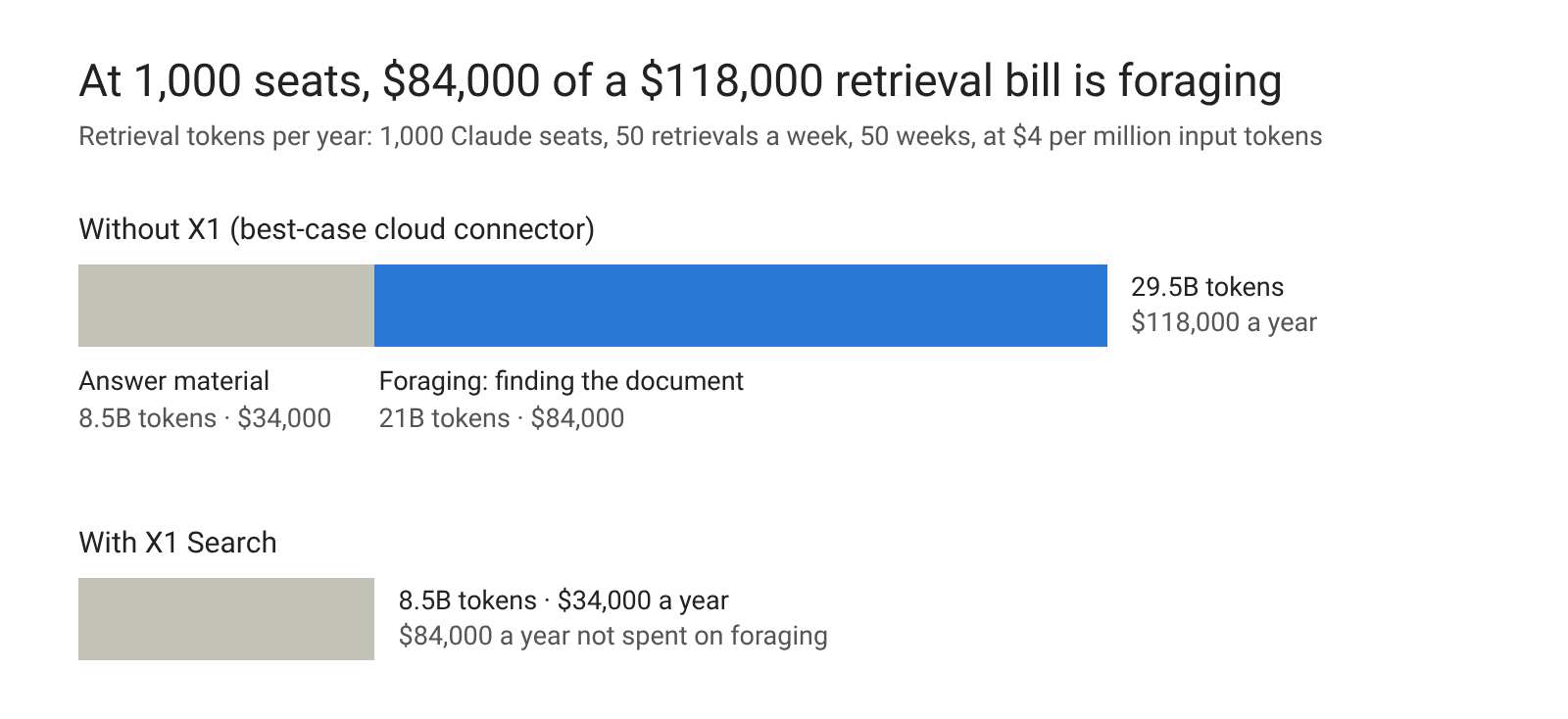
Low-end figures from the table above: measured test results applied to 1,000 seats, 50 retrievals a week, 50 weeks; Claude Opus 5.5 list price of $4 per million input tokens
The grey block is the same in both bars: the material that actually answers the question. X1 removes the blue block and leaves the answer untouched.
Agents make this steeper, not flatter. A person asks fifty times a week. An agent working through a research task or a contract review can make fifty retrievals before lunch. And wherever a workflow touches raw files instead of extracted text, the multiplier moves from 3.5x toward 55x.
At organizational scale, those savings show up in three places.
1. Less data leaves your endpoints
This is the one I’d put in front of your security team. Every foraging step is an egress event. On the cloud path, one question pulled twenty-five emails’ worth of snippets and a full five-message thread into model context, including customer matters, deal fragments, and third-party contact details the question never needed. At a thousand seats, that is more than a million unneeded snippets a week crossing from your tenant into model context.
No single one of those is a breach. Together they are an exposure surface your security team never approved and can’t easily measure. With X1 on every endpoint, the default flips: search runs locally, and only the responsive rows and the one document that answers the question go to the model. Data minimization stops depending on how carefully each user or agent phrases a request. Minimization isn’t a policy you hope agents follow; it’s a property of the architecture.
2. Tokens go to results, not foraging
On the cloud path, roughly 70% of the tokens in my test went to finding the document and 30% to the material that answered the question. With X1, that ratio inverts: nearly every token is the answer’s raw material.
That matters beyond the bill. Tokens spent paging through search results occupy the context window, slow the response, and crowd out the reasoning you deployed Claude for. An organization that gives every Claude user a local index gets more analysis, drafting, and decisions out of the same token budget, because the model starts each task with the right document instead of a search problem.
3. Token charges and quotas become manageable
Foraging cost is open-ended. It depends on how many pages of results come back, how long the thread is, and how large the attachment turns out to be. That makes usage hard to forecast and easy to exhaust. Heavy users hit their limits mid-task, and consumption-based bills move with factors nobody chose.
Retrieval through X1 is bounded: a handful of result rows plus the documents actually needed. Whether you buy Claude by the seat with usage limits or by consumption, bounded retrieval means quotas stretch further, fewer people run out before the work is done, and finance gets a number it can plan around. The connector’s built-in savings audit, described below, gives you the evidence per endpoint, so the organization-wide figure is measured rather than estimated.
The catch is coverage. These benefits arrive seat by seat. A Claude user without X1 on their endpoint is still foraging, still sending the wider payload, still drawing down the shared budget at 3.5x. The savings compound only as far as the license does.
Don’t take the narrator’s word for it
One of my favorite moments in the demo isn’t scripted by us at all. After both runs, you can simply ask Claude: “Report on the work you just did: every tool call, the size of each result, what of my data entered your context, and whether any document bytes were transferred.” The model itemizes its own behavior, names the unrelated matters it saw on the API path, and flags what it never needed. Then ask it to compute what the raw base64 fetch would have cost, and it does the arithmetic live.
The X1 connector also keeps its own receipts. A built-in cost-savings audit compares actual X1 token usage against what the installed cloud connector would have cost for the same retrievals, with honest low and high bounds and per-category evidence, recorded by the bridge itself rather than asserted on a slide. Run it on a pilot group and you have your own organization’s multiplier, from your own data, before you commit to a broad rollout.
A note on methodology, because credibility matters more than a bigger multiplier. The token figures above are payload-size estimates from a live run on my real mailbox, not billing-grade counts, and the raw-API number is computed from the actual file size rather than executed. The organization-level table is simple multiplication of those figures, not a measurement. The ratios are what’s defensible, and they hold under any tokenizer, because they’re driven by architecture, not by the particular document.
Bring Search to the AI on every endpoint with X1
The industry’s default pattern is to bring the data to the AI: copy it, upload it, mirror it into someone else’s cloud, then let the model forage through it. X1’s answer is to bring search to the AI instead. The data stays where it lives, indexed in place and enriched locally on each endpoint. Claude asks X1 a question and gets back only the responsive subset: permissioned, minimized, and audited.
Claude answers the question. X1 makes sure that’s all it has to do.
If your organization has already deployed Claude, you’ve already made the larger investment. X1 Search 12 with the MCP Connector is how you make every seat of it leaner, safer, and more predictable:
- Security teams get data minimization enforced by architecture on every endpoint, not by policy.
- Claude users get answers in two calls, with the context window left for the actual work.
- Finance and IT get bounded, auditable token consumption and quotas that last.
Deploying Claude across your organization? License X1 Search 12 for every Claude user and let the savings compound. Contact us or email sales@x1.com to scope an organization-wide rollout or start a measured pilot.
Want to see it on your own machine first? The MCP Connector for Claude is included in X1 Search v12, available now. Get X1 Search at 25% off during our Black Friday sale, through Cyber Monday, November 30.