Q&A With DLA Piper Social Media Practice Group Co-Chair Joshua Briones, and Fellow Group-Member Ana Tagvoryan

Ana Tagvoryan

A. Tagvoryan

J. Briones

J. Briones

Today we are pleased to welcome Joshua Briones and Ana Tagvoryan for a special Q&A session about social media evidence discovery.  Joshua is a partner at DLA Piper and co-chair of the firm’s Social Media Practice Group.  Ana is also at DLA Piper and a member of the firm’s Social Media Practice Group.  Joshua and Ana advise clients regarding compliance with state and federal laws, which govern the use and disclosure of consumer information, and associated FTC regulations, privacy, the cloud, social networks, blogs, and other user-generated web content and on privacy and Internet-related class actions. Each is a co-author of the legal practice guide, Social Media as Evidence: Cases, Practice Pointers and Techniques, published by the American Bar Association.  It is a highly practical book that we highly recommend, available for purchase online from the ABA here.

Q: Your book emphasizes that every litigator needs to understand and utilize social media evidence.  What do you say to the “old school” litigator who is more skeptical?

A:

Joshua:  Social media has become an evidentiary gold mine for impeaching witnesses and undermining a party’s litigation position. Eighty percent of Americans who are online now regularly use some form of social media. The proverbial “smoking gun” email has now given way to the smoking gun social media post. But there is a misperception that information on social media sites is private or limited to “friends” of the post. In reality, much of the information on social media sites is not private, and it can often be accessed or seen by complete strangers. For litigators, there is little question that litigation now regularly involves social media data as evidence, but it is essential that your litigation support staff or hired service provider has the requisite expertise and the right tools to capture and preserve this information.

Ana:  In addition, if it hasn’t happened already, it is only a matter of time before an attorney faces a malpractice claim for failing to review publicly available social media data.  In certain cases, social media data that is publicly available on a party or key witness could hurt or strengthen a party’s position and affect the outcome.  It is now a matter of basic due diligence for attorneys to review such data at the outset of a case and to be aware of it.

Q: You mentioned impeaching witnesses — many litigators assume that generally means younger folks and individual Plaintiffs, but you make some very compelling points about expert witnesses.

A:

Joshua:  Yes. Just about every expert witness these days has a blog, contributes to other blogs or regularly uses Twitter or Facebook.  Sometimes they do all three, as many experts these days seek to build an online brand as “knowledge leaders.” You can also find online videos of their presentations or lectures. It’s good for litigators to consider thoroughly researching these sources regarding opposing experts as well as for performing due diligence on their own expert witnesses. Additionally, lawyers may want to include in the expert’s engagement letter that they will not discuss the case on social media or blog sites until the case is completely over, including appeals, and, further, that anything discussed with the client or its counsel during the case that was not disclosed at trial is confidential and should never be disclosed.

Q: What are some of the finer points of social media evidence that corporate counsel should be aware of?

A:

Ana:  Obviously a company’s official social media account is going to be discoverable in a litigation matter, but in many cases an employee’s personal social media account may be discoverable as well, depending on company policies and procedures. For instance, if a company’s IT policy states that the business owns everything created, stored, sent or received on company equipment, then a court might find that the company owns – and therefore controls – any social media created by an employee at work or on a company computer, and which is germane to the issues in the litigation. Companies should therefore closely review their written IT policies which may have been written several years ago and thus did not take social media into account. All document retention policies and litigation hold procedures should also take social media data into account.

Q: For a party’s social media data that is behind privacy settings and available to “friends only” what is the current trend with courts treating this data as discoverable?

A:

Joshua:  While not allowing unfettered fishing expeditions into opponents’ social media accounts, courts are compelling production of non-public social media evidence where there is a showing of potential relevance. So while there is a relevance threshold as with all forms of discovery, courts are not recognizing any right to privacy when it comes to non-public social media content. In fact, judges in key decisions have noted that the “very nature and purpose” of social media sites is to share personal information with others in a very public form.

Ana:  Yes, all this is true even though the poster believed the posting would be confined to the “private” social media account or page. Stripped of the trappings of their newness, social media postings are no different from other types of communication — whether private or otherwise — that courts have allowed parties to obtain in discovery in civil litigation.  Even where access to content is limited to “friends” one court noted that the average Facebook user has 130 friends, who could share posted information with their “friends” and “friends” of “friends” and so on.   This why the court in Romano v. Steelcase noted that for social media content, “privacy is no longer grounded in reasonable expectations, but rather in some theoretical protocol better known as wishful thinking.”

Q: Thank you Joshua and Ana. Is there anything else you would like to say in closing?

Ana:  Social media is not monolithic. It’s constantly changing and doesn’t exist in isolation from other information sources.  As such, a litigation-focused social media strategy should rely upon multiple sources; it should also cross-reference leads against disparate information sources (e.g., accounting records, email, sales presentations, and property records).

Joshua:  Social media is increasingly being used as a source of potentially useful evidence.  By effectively obtaining and strategically using social media in the litigation context, counsel can likely be better prepared — and better prepare their clients — to respond to social media data challenges.  It is in this regard that we are uniquely well suited to provide our clients with creative, forward-looking, and timely legal services.

___________________________________

For more information about X1 Social Discovery, the leading social media discovery solution, please visit here.

4 Comments

Filed under Uncategorized

Microsoft’s Lessons for the eDiscovery Industry

Microsoft imageThe announcement that Microsoft CEO Steve Ballmer is set to retire within 12 months naturally spurred some thought on the analogous plateauing or even demise of prominent eDiscovery software firms in recent years. In my view, there are two general lessons to be gleaned by the eDiscovery industry from Microsoft’s troubles.

The first is about the speed of change in this industry. Three years ago, the PC was king and predictive coding was a fairly obscure term. Now, mobile devices, cloud, social media and desktop virtualization have relegated the traditional PC to the road to legacy status. And we all know the story of the tidal wave that is the predictive coding craze of 2013.

And this leads to the second and related lesson, which is the difficulty for dominant companies to stay innovative in such a fast-changing environment. This past week featured a lot of commentary from business and technology pundits, mostly making fairly obvious points about Microsoft missing the boat on smart phones, tablets and the Vista and Windows 8 debacles. But in terms of the bigger picture, I like the analysis from Nobel prize-winning economist Paul Krugman, who summoned wisdom from 14th Century North African philosopher Ibn Khaldun:

“One insight (Khaldun) had, based on the history of his native North Africa, was that there was a rhythm to the rise and fall of dynasties. Desert tribesmen, he argued, always have more courage and social cohesion than settled, civilized folk, so every once in a while they will sweep in and conquer lands whose rulers have become corrupt and complacent. They create a new dynasty — and, over time, become corrupt and complacent themselves, ready to be overrun by a new set of barbarians.

I don’t think it’s much of a stretch to apply this story to Microsoft, a company that did so well with its operating-system monopoly that it lost focus, while Apple — still wandering in the wilderness after all those years — was alert to new opportunities. And so the barbarians swept in from the desert.”

And I think it’s even less of stretch to apply this story to the eDiscovery software industry. For instance, in speaking to a couple of eDiscovery executives last week, they lamented that a dominant review tool his company relies on, had in their opinion become “long in the tooth” with the executives of that software provider no longer very accessible. Another leading eDiscovery software vendor recently launched a major upgrade to their flagship product resulting in palpable user exodus as the new version was much more complex, with a brand new interface that fell flat. Basically straight out of the Windows 8 playbook.  Not be outdone in its loss of focus, a similar and also market leading company now supports, by my count, at least 12 different products and at least 5 different markets.

And I think this trend of disruption is accentuated in the eDiscovery field because even the dominant players do not have several million in idle funds for research and development into cutting-edge technologies that will not produce meaningful revenue in the near term. Instead, they have to answer to investors of various stripes who demand that quarterly revenue numbers and positive near term cash flow are met. It’s the classic innovators dilemma.

What this means for key buyers of eDiscovery software is that they should be open to change and consider avoiding lock-in with seemingly dominate vendors who could only be months away from being displaced by the barbarians from the desert.

Leave a comment

Filed under eDiscovery & Compliance, Enterprise eDiscovery

Social Media Evidence at the Center of the A-Rod Suspension

Earlier this month, Major League Baseball took the unprecedented step of suspending a star player, Alex Rodriguez, for two years due alleged illegal use of performance enhancing drugs (PEDs). Yankee playerWhile the suspension of one of baseball’s greatest players of all time made the headlines, the critical role social media evidence played in tying “A-Rod” to Biogenesis, the company which allegedly provided him with the PEDs, is an important sub-story. While we are not at liberty to discuss any details of the social media investigation software used by any of the parties, this Associated Press report describes a detailed, thorough and highly professional investigation of the social media evidence involved.

Specifically, investigators collected key evidence from publically available Facebook posts and Tweets from associates of the targets, which apparently proved to be the most effective source of evidence. Per the AP: “Baseball investigators examined the Facebook pages of (Biogenesis founder Anthony) Bosch and Porter Fisher, the former Biogenesis associate who gave documents to the newspaper. They began to sketch out which people they were friends with, and which of those friends posted photos of athletes or mentioned athletes. Each link led to new loops that provided leads.”

In response to the investigation, MLB players’ union general counsel David Prouty noted that social media evidence “adds a layer of proof that certainly wasn’t available many years ago.”

This type of thorough investigation of publically available social media evidence is only possible with best practices technology that enables scalable and automated collection of up to millions of items preserved and organized in a single case in an instantly searchable and reviewable format.

Given its very high profile and the high stakes involved (The suspension could cost A-Rod over $100 million) the A-Rod case represents a seminal development in the field of social media and Internet investigations. According to the media reports, this is not a situation where social media evidence merely served a supporting role, but was a difference-maker that apparently formed the basis of the suspension.

No need to comment further.

1 Comment

Filed under Best Practices, Social Media Investigations

Zimmerman Prosecutors Also Missed Key Website Evidence

As an epilogue to our recent post identifying various relevant social media evidence missed by prosecutors in the State of Florida vs. George Zimmerman prosecution, another instructive moment illustrated the importance of general website evidence and why many of our law firm clients tell us they capture website evidence on a daily basis. I’ll have more on that second point later.

Zimmerman’s lawyers called Mixed Martial Arts (MMA) trainer Adam Pollock, who trained George Zimmerman at his Florida gym from October of 2010 until “the end of 2011″— about two months before the shooting of Trayvon Martin. The defense, with apparent success, cited Pollock’s testimony to establish that the former neighborhood watch volunteer was an unaccomplished fighter and ineffective at self-defense. “He was an overweight, large man when he came to us, a very pleasant, very nice man, but physically soft – predominantly fat,” Pollock testified. “Not a lot of muscle. Not a lot of strength.” “He was about a 1,” said Pollock, when asked to rank Zimmerman’s athletic skill on a scale of 1 to 10.

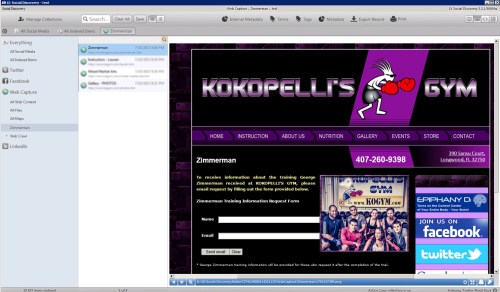
It turns out however, that Pollock’s gym prominently and proudly advertised George Zimmerman as their client, offering information about obtaining the same self-defense training he received:

Zimmerman 2Click image to enlarge

This evidence, which was captured by X1 Social Discovery, would suggest bias and arguably contradicts Zimmerman’s lawyers assertion that he lacked self-defense prowess. The prosecution did not have this information available on cross-examination and, apparently learning of it at a later time, tried to re-call Pollock as a rebuttal witness. However, the court sustained the defenses’ objection on procedural grounds, noting that the State should have raised the issue on cross-examination. Also, as a side note, this web page had been deleted by then.

This is just one illustration as to why our larger law firm clients tell us they employ X1 Social Discovery on a daily — sometimes hourly — basis, as website evidence factors prominently into many types of legal matters. Witnesses often maintain personal websites or are employed by a company with a large website that often harbors bits of key information buried in the recesses of the site, yet are publicly available.

As such, all available website evidence associated with parties and witnesses should be preserved when their identities become known. Due diligence for mergers and acquisition and other securities matters, compliance monitoring, and discovery related to business disputes and intellectual property are other use cases that require extensive capture analysis of website data.

But only best practices technology that provides a scalable, automated, defensible and cost-effective capability enables website collections to be performed on a routine and standard basis. Simple screen captures are not defensible, do not scale as they only allow very limited coverage of an entire site, do not collect source page data (which often presents key evidence) and do not allow for instant search of the collected data, which is essential for a scalable and effective process. With tools like X1 Social Discovery, website data can be collected either on a single web capture or by crawling an entire site consisting of thousands of pages. Additionally, the data is instantly searchable and subject to litigation review process with filtering, intuitive first pass review, tagging, and finally export to attorney review platforms for tertiary review and production.

As with the case of other forms of electronic evidence collection, the compelling legal requirement exists long before scalable, automated and cost-effective technical solutions are developed. Now that such tools are available, we are seeing more and more legal professionals bake-in website evidence capture, along with social media, into their routine discovery processes.

Leave a comment

Filed under Uncategorized