Category Archives: eDiscovery

How Case Teams Can Streamline Collections with X1 in RelativityOne

Editor’s’ Note: This article originally appeared on The Relativity Blog. It is reprinted here in full with permission. 

by Sam Bock on November 07, 2019

Our September 2019 release for RelativityOne debuted some game-changing functionality in the platform. Collect for RelativityOne enables fast, secure, and defensible collections right within the cloud, allowing RelativityOne users to pull data directly from Microsoft Office 365 without ever leaving the platform or Azure.

One of our developer partners—X1—joined up with us on building this functionality, bringing their patented technology into Collect to help simplify traditionally complex workflows.

To get a better picture of just what Collect and X1 Distributed Discovery are capable of now that they’ve teamed up, we sat down with X1 Executive Chairman and Chief Legal Officer John Patzakis. Check out the most impactful takeaways from our conversation, and sign up for X1’s upcoming webinar to learn more.

Sam: What makes collection challenging for today’s legal teams?

John: Traditional e-discovery collection methods consist of either unsupervised custodian self-collection or manual services, driving up costs while increasing risk and disruption to business operations. On the other end of the spectrum, endpoint forensic imaging is burdensome, expensive, and not legally required for civil litigation discovery. Additionally, these manual and disjointed efforts are not technically integrated with Relativity, thus requiring multiple hand-offs, which increases risk, expense, and cumbersome project management efforts.

How does your team think creatively to tackle those challenges in the interest of conducting faster, more defensible collections for your customers?

We tackle collection from the enterprise and also enable significant scalability. X1 Distributed Discovery enables enterprises and their service providers to search, assess, and analyze electronically stored information (ESI) across hundreds or even thousands of custodians, enterprise-wide, where the data resides and before collection, with direct upload into Relativity. Instead of the expensive and disruptive “image then stage then process then load into review workspace” process, X1 Distributed Discovery allows for access to ESI where it sits within hours.

What sorts of variables exist in today’s collection workflows, and how does your team accommodate for those differences?

One of the biggest challenges with modern enterprise ESI collection comes from remote employees who only log into the network intermittently. Most network-enabled collection tools require custodians to be on the domain in order to work. However, X1 is architected to feature SSL security certificates—creating secure tunnels that enable collection from custodians wherever they are, including on WiFi in a Starbucks or on a plane.

Another key challenge is email collection. Traditional workflows often require collecting an entire PST email container or Exchange email account back to a central location for processing, identification, and preservation of potentially responsive email messages. This approach involves the transferring and processing of large files, which takes a lot of time, before even beginning to identify individually responsive email messages. Our solution eliminates the need to transfer entire email containers by allowing the identification and collection of individual messages in place on a custodian’s computer.

How is Collect for RelativityOne built to manage modern collections more effectively?

Collect integrates the X1 Distributed Discovery architecture to leverage patented search technology that indexes Microsoft Office 365 data directly on the laptop, desktop, or file server, allowing e-discovery, investigatory, or forensic professionals to globally query thousands of individual endpoints simultaneously. Individual emails and files can be identified by keyword, dates, and other metadata content without having to first retrieve the entire PST or ZIP across the network.

Collecting enterprise ESI can be one of the most daunting parts of the e-discovery process, and X1’s technical integration with RelativityOne seeks to make it less intimidating. The software helps streamline the e-discovery workflow by eliminating expensive and cumbersome processing steps and dramatically increasing speed to review. Collect for RelativityOne provides legal teams with a solution that compresses project timeframes; reduces risk by integrating collection with the rest of Relativity’s suite of features for review and analysis; and creating a repeatable process that helps reduce overall efforts and costs that might otherwise be spent outside of the platform. Additionally, the tight integration between X1’s technology and Relativity provides a unified chain of custody for optimal defensibility.

In short, we’re excited to see how this functionality, built into Relativity’s collection tool, can help revolutionize the current e-discovery process by collapsing the many hand-offs involved in the EDRM into a few short steps manageable by one or two people.

What tips and best practices would you share with a team conducting complex collections? How can they set themselves up for success from the start?

When collecting data, plan your collection criteria carefully. Focus on granular search criteria including file types, data ranges, and other key metadata in addition to detailed Boolean search terms to help your team strategically reduce collection volumes.

Sam Bock is a member of the marketing team at Relativity, and serves as editor of The Relativity Blog.

Leave a comment

Filed under collection, Corporations, eDiscovery, Enterprise eDiscovery, Uncategorized

Social Media Statements: Key Evidence and Often Exceptions to the Hearsay Rule

By John Patzakis

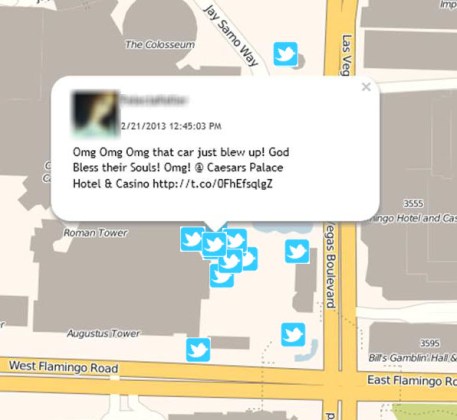
Here is a quick legal evidence quiz: Identify the three distinct hearsay exceptions in the following Tweet:

Accident 5


The first exception would be under Federal Rule of Evidence 803(2):

“Rule 803. Exceptions to the Rule Against Hearsay: . . . (2) Excited Utterance. A statement relating to a startling event or condition, made while the declarant was under the stress of excitement that it caused.”

Pretty clear here. The four OMGs are a good indication. So no one can argue that the phrase “OMG” never has any legal consequence.

The second exception would be under FRE 803(1): “Present Sense Impression. A statement describing or explaining an event or condition, made while or immediately after the declarant perceived it.”

And if the witness some time later did not recall details of the incident (two words: Vegas, hangover), the statement could be introduced as a recorded recollection under 803(5).

Another key hearsay exception are statements offered as evidence of the then state of mind of the declarant. While YouTube is known for cat videos, Twitter and Facebook are in large part a platform for statements like this:

Happy Tweet


In other words, to quote FRE 803(3): “Then-Existing Mental, Emotional, or Physical Condition. A statement of the declarant’s then-existing state of mind (such as motive, intent, or plan) or emotional, sensory, or physical condition (such as mental feeling, pain, or bodily health)”

While social media is a great place to find out what Kim Kardashian and Justin Bieber are thinking or feeling on a given day, the state of mind of a party or witness is a common issue in many legal matters. (See Gordon v. T.G.R. Logistics, Inc. (D. Wy. May 10, 2017) (Court orders production of entire Facebook Account history as relevant to mental and emotional state of Plaintiff)).

And finally, arguably the most compelling social media evidence stems from the propensity to self-incriminate oneself on Twitter, otherwise known as a Statement Against Interest under FRE 804(b)(3).  This takes multiple forms, including flat out admissions of liability, or previous statements that contradict or otherwise impugn the integrity of a declarant. For instance:

Trump tweet


The bottom line is that social media provides a treasure trove of evidence that also tends to fall under evidentiary hearsay exceptions, unlike other forms of out of court statements.

But if you are offering social media evidence under a hearsay exception in court, that would likely mean you have an uncooperative or otherwise unavailable party who authored the social media statement in question. In such cases, the authenticity of the post must be established through circumstantial evidence since direct testimony is not available, and you will need the right software to both identify such evidence and properly collect it utilizing best practices to ensure its admissibility in court.

1 Comment

Filed under Authentication, Best Practices, Case Law, Case Study, eDiscovery, Social Media Investigations

Want Legal to Add A LOT More Value? Stop Over-Collecting Data

blog-cassting-net

The 2019 CLOC (Corporate Legal Operations Consortium) Conference ended last week, and by all accounts it was another great event for an organization that continues to gain relevance and momentum.  A story in Thursday’s Legaltech News entitled “Why E-discovery Savings Is About Department Value for Corporate Legal” summarized a CLOC session focused on “streamlining e-discovery and information governance inside corporate legal departments.”  At the risk of sounding biased, that seems like a perfect topic to me.

The article’s conclusions from the panel session, namely adding value by wresting control of eDiscovery from outside counsel, consolidating hosting vendors and creating a “living data map”, were all spot on and certainly useful.  One way for legal to add enormous value, however, was NOT discussed: collecting far less data as part of the eDiscovery, investigatory and compliance processes.

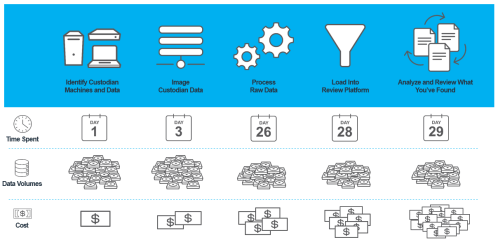
As we highlighted on an insightful webinar with our partner Compliance Discovery Solutions last Tuesday (which can be viewed here), the way most eDiscovery practitioners conduct ESI collection is remarkably unchanged from a decade ago, an example of which is shown in the infographic below: consult a data map, image entire drives from each and every custodian (e.g. with EnCase), load these many images into a processing application (e.g. Nuix), process these huge amounts of data (most of which is entirely irrelevant), then move this now-processed data into a review application (e.g. Relativity).

blog-legacy-collection-infographic

This legacy collection process for GRC (Governance, Risk & Compliance) and eDiscovery is wildly inefficient, disruptive to the business and costly, yet many if not most practitioners still use it, most likely because it’s the status quo and change is always hard in the legal technology world.  But change here is a must, as this “image everything à then process it all à and only then begin reviewing” workflow causes myriad issues not just for legal but for the company as well:

  • Increases eDiscovery costs exponentially. The still-seminal Rand study on eDiscovery pegged an overall cost-per-GB for identification through production of $1,800/GB.  While some elements of this price have come down in the intervening 6-7 years, especially processing and hosting rates, data volumes and variety have grown by at least as much thereby negating these reductions.  Imaging entire drives by definition collects far more data than could ever be relevant in any given matter – and the costs of this overcollection multiply every step thereafter, forcing clients to pay hundreds of thousands if not millions of dollars more than they should.
  • Is extremely disruptive to employees. Forensically imaging a drive usually requires gaining physical access to the laptop or desktop for some period of time, often for a day or two.  Put yourself in each of those employee’s shoes: even if you are given a “loaner” machine, you still don’t have all of your local information, settings, bookmarks, etc. – which is a major disruption to your work day and therefore a significant drag on productivity.
  • Takes far too long. With forensic imaging of drives requiring physical access to a device, each custodian’s machine must be dealt with.  In many collections, custodians are spread across multiple offices, or on vacation, or remote employees, which often extends the process to many weeks if not months.  All of this time lawyers are unable to access this critical data (e.g. to begin formulating case strategy, negotiating with opposing counsel or a regulator, etc).
  • Creates unnecessary copies of data that could otherwise be remediated. An often-overlooked byproduct of over-collection is that it creates another copy of data that is outside of most (if not all) data remediation programs.  For companies that are regulated and/or encounter litigation regularly, this becomes a major headache and undermines data governance and remediation programs.
  • Forces counsel to “fly blind” for months. Every day the IT and legal teams are spending forensically imaging each custodian’s drives, then processing it, and only then loading it into a review or analysis application is a day in-house and outside counsel are flying blind, unable to look at key data to begin constructing case strategy, conduct informed interviews, negotiate with opposing counsel (e.g. on the scope of a matter, including discovery) or interact with regulators.  This is incredibly valuable time lost for no value received in return.
  • Using forensic tools for non-forensic processes is unnecessary overkill. The irony of this “image everything” approach is that it is extreme overkill: it would be like a doctor whose only procedure to get rid of a mole was to cut off the arm.  Forensic images can always be utilized on a one-off basis in narrow circumstances where there are concerns about possible spoliation of evidence, but for the vast majority of circumstances, a forensic image is completely unnecessary.

As was a focus at the recent CLOC conference in Las Vegas, corporate legal operations are quite correctly focused on showing the value legal is bringing to the business.  However, there is still a fundamental change they need to make to how they handle the collection of ESI for eDiscovery, GRC and privacy purposes that would be an enormous value-add to all parts of the company, including legal: ending the systematic over-collection of data.  How this can be done quickly and cost-effectively has been the subject of previous blog posts, but will be addressed in detail in the next few weeks as well.

Leave a comment

Filed under Best Practices, collection, compliance, Data Audit, eDiscovery, Enterprise eDiscovery, Uncategorized