
Category Archives: Case Law

Court Decision in Lubrizol vs. IBM Provides Important Guidance on MS Teams Discovery

By John Patzakis

Recently, a federal district court in Ohio issued a ruling concerning an eDiscovery dispute involving both Teams and Slack, Lubrizol Corp. v. IBM Corp., No. 1:21-CV-00870-DAR (N.D. Ohio May 15, 2023). This decision is important as it provides and serves as a template and guidepost on how to collect and produce messages from MS Teams, a challenge which many litigants are struggling with today.

This case involves a breach of contract claim where plaintiff Lubrizol corporation, a major chemical manufacturer, purchased an SAP ERP system, and then hired IBM to implement the enterprise software. The project eventually went off the rails and now the parties are in litigation fighting over eDiscovery.

As you might imagine on an IT project like this, there’s a lot of evidence in Teams and also in Slack. Plaintiff Lubrizol wanted IBM to produce the entire channel of their messages if there was even a single relevant message within the channel. However, in its written opinion, the court determined that the production of an entire Slack or Teams channel, with only a few relevant messages within, would be overbroad per the rules of proportionality. IBM conversely took a counter position that was equally extreme, claiming that they only needed to produce the actual message that the keyword hit on without any context of the broader conversation around it. The court rejected this approach.

Eventually the plaintiff came back to the court with a proposed compromise, which the court agreed with and adopted as its final order as follows:

“IBM to produce: (1) the entirety of any Slack conversation containing 20 or fewer total messages that has at least one responsive message; and (2) the 10 messages preceding or following any responsive Slack message in a Slack channel containing more than 20 total messages. Within 28 days, Lubrizol shall do the same with respect to its Microsoft Teams messages.”

While this ruling is very instructive, many parties struggle with executing such a targeted collection and production effort. The problem with Teams discovery, as outlined in a previous post, is that most eDiscovery tools require parties to collect and export entire Teams channels, with the production format being very problematic due to no efficient ability to provide automated and targeted productions as the court outlines above.

The exception is X1. X1 Enterprise Collect provides, in our opinion, the industry’s best eDiscovery support for MS 365. And many independent eDiscovery, experts, agree. X1’s support for MS Teams is one example. Among the reasons why our MS Teams support stands out, is the ability to produce a specific number of preceding and subsequent messages for automated input into a review platform, all in context. See the screenshot below.
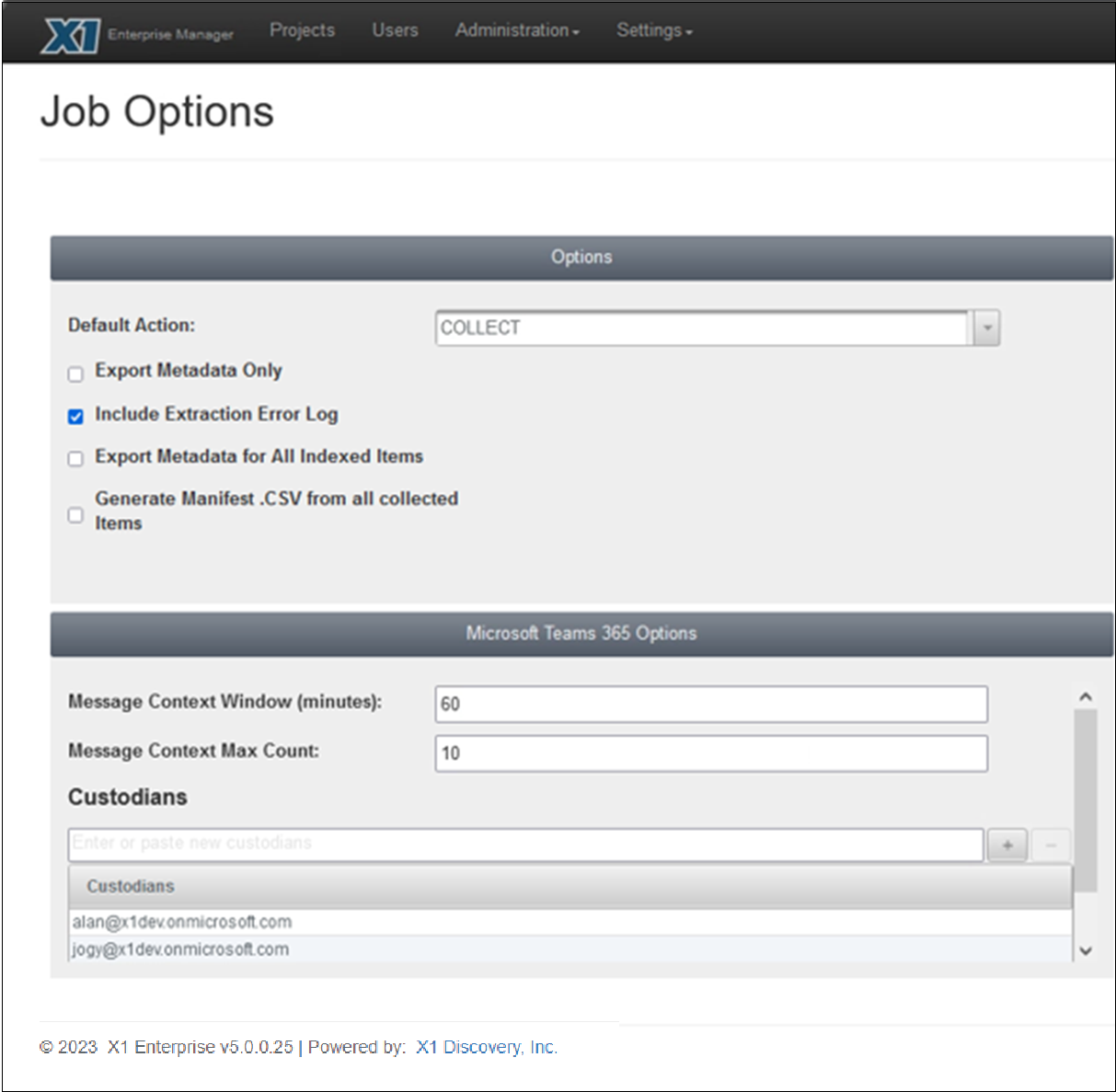
Winston & Strawn eDiscovery partner Bobby Malhotra notes the importance of this capability: “With the vast number of users and unyielding amount of data in collaboration applications such as Teams, having the ability to target and triage data by specific custodians and threads allows organizations to handle discovery in an efficient and pragmatic manner. X1 provides the unique ability to seamlessly collect and search across numerous web, collaboration, and social, data sources.”

X1 recently hosted a webinar demonstrating how to collect from MS Teams in an effective, defensible and proportional manner. You can watch it here on demand.

The X1 Enterprise Collect Platform is available now from X1 and its global channel network in the cloud, on-premise, and with our services available on-demand. For a demonstration of the X1 Enterprise Collect Platform, contact us at sales@x1.com. For more details on this innovative solution, please visit www.x1.com/x1-enterprise-collect-platform.

1 Comment

Filed under Best Practices, Case Law, Cloud Data, ECA, eDiscovery, eDiscovery & Compliance, Enterprise eDiscovery, law firm, MS Teams, Preservation & Collection

Proportionality in eDiscovery is Ideal, but Difficult to Realize Without an Optimized Process

By John Patzakis

(Originally published October 24, 2022 by JD Supra and EDRM)

Image: Kaylee Walstad, EDRM

Proportionality-based eDiscovery is a goal that all corporate litigants seek to attain. Under Federal Rule of Civil Procedure 26(b)(1), parties may discover any non-privileged material that is relevant to any party’s claim or defense and proportional to the needs of the case. Litigants that take full advantage of the proportionality rule can greatly reduce cost, time and risk associated with otherwise inefficient eDiscovery.

While there is a keen awareness of proportionality in the legal community, realizing the benefits requires the ability to operationalize workflows as far upstream in the eDiscovery process as possible. For instance, when you’re engaging in data over-collection, which in turn incurs extensive labor and processing costs, the ship has largely sailed before you are able to perform early case assessments and data relevancy analysis, as much of the discovery costs have already been incurred at that point. The case law and the Federal Rules provide that the duty to preserve only applies to potentially relevant information, but unless you have the right operational processes in place, you’re losing out on the ability to attain the benefits of proportionality.

However, traditional eDiscovery services typically involve manual collection, followed by manual on-premises hardware-based processing, and finally manual upload to review. These inefficiencies extend projects by often weeks while dramatically increasing cost and risk with purposeful data over-collection and numerous manual data handoffs. The good news is that solutions and processes addressing the first half of the EDRM involving collection and processing are now far more automated than they were even a few years ago.

Recently EDRM hosted a webinar addressing these issues – “Operationalizing your eDiscovery Process to Realize Proportionality Benefits” – and more specifically, as the title reflects, explored how to operationalize your eDiscovery process to achieve lower costs, improve early case strategy, realize faster time to review and reduce overall legal risk.

Here are some key takeaways from the webinar:

  • A detailed legal analysis was provided highlighting the case of Raine Group v. Reign Capital, (S.D.N.Y. Feb. 22, 2022), which applied proportionality at the point of identification and collection, not just production. The court endorsed the use of detailed and iterative keyword searches to identify and preserve potentially relevant ESI.
  • A demonstration was shown on how to enable detailed and proportional search criteria, applied in-place, at the point of collection. Such a capability is key to realizing the blueprint for targeted and proportional ESI collection outlined in Raine Group.
  • The speakers also discussed how organizations should move upstream to focus on information governance to reduce the data funnel as soon as possible. The new generation of eDiscovery technology in the areas of collection, identification, analytics, and early data assessment, enables enterprises to operationalize proportionality principles.

The webinar culminated with the notion that an optimized process that applies proportionality upstream at the collection and identification stage reduces the data volume funnel by as much as 98 percent from over-collection models, yet with increased transparency and compliance. A link to the recording from the webinar can also be accessed here.

Leave a comment

Filed under Best Practices, Case Law, Case Study, ECA, eDiscovery, Enterprise eDiscovery, ESI, Preservation & Collection, proportionality

Relativity and X1 Publish Updated Joint Legal Whitepaper on ESI Collection Best Practices

By John Patzakis

Relativity and X1 have published an updated joint legal whitepaper addressing full-disk imaging as a disfavored collection practice in civil litigation, with Relativity eDiscovery attorney David Horrigan as the lead author. This paper is a substantive update from the original published a year ago, adding discussion of important and relevant new case law published in the past 12 months. The paper notes that “if the preliminary data from the first five months of 2022 are any indication, we may be seeing that the law of proportionality is becoming more settled — and that courts continue to disfavor full-disk imaging.”

The paper delves into all the legal reasons, including detailed analysis of case law, the Federal Rules of Civil Procedure, and the Sedona Principles establishing why forensic collection is not required in civil litigation. The paper primarily focuses on the principles of proportionality in its legal analysis as well as case law issued prior to the 2015 amendment to the Federal Rules of Civil Procedure, which gave greater prominence and clarification of the proportionality rules.

One of the recent updated cases included is Besman v. Stafford, where the appellate court reversed and remanded a trial court’s order of a forensic examination of a law firm computer, holding the trial court erred in failing to take precautions to protect the privileged and confidential information on the device. “Generally, courts are reluctant to compel forensic imaging, largely due to the risk that imaging will improperly expose privileged and confidential material contained on the hard drive,” Judge Anita Laster Mays wrote for the appellate court.

This is an important topic as a key problem in eDiscovery that drives inefficiencies and higher costs is that default collection methods often involve full-disk imaging—a forensic examination of an entire computer—when searching for responsive data. As the whitepaper notes, “it turns out full-disk imaging is not required for most eDiscovery collections. In fact, courts often disfavor the practice.”

A copy of the whitepaper can be found here.

Leave a comment

Filed under Best Practices, Case Law, collection, eDiscovery, eDiscovery & Compliance, Enterprise eDiscovery, ESI, proportionality, Relativity

Industry Experts: Proportionality Principles Apply to ESI Preservation and Collection

By John Patzakis

Under Federal Rule of Civil Procedure 26(b)(1), parties may discover any non-privileged material that is relevant to any party’s claim or defense and proportional to the needs of the case. Lawyers that take full advantage of the proportionality rule can greatly reduce cost, time and risk associated with otherwise overbroad eDiscovery production. In a recent webinar, eDiscovery attorney Martin Tully of Redgrave LLP, addressed how to use processes and best practices to operationally attain this goal, particularly in the context of preservation and collection. In addition to being a partner at the Redgrave firm, Tully is currently the chair of the Steering Committee of the Sedona Conference Working Group on Electronic Document Retention and Production (WG1), providing additional import to his comments on the subject.

During the webinar, Tully noted that the “duty to preserve is directly aligned with what is within the scope of discovery….so if something is not within the scope of discovery – that is its either not relevant or its not proportional to the needs of the case — then there should not be an obligation to preserve it in the first place.” Tully discussed at length the recent case of Raine Grp. v. Reign Capital, (S.D.N.Y. Feb. 22, 2022), which holds that under FRC 26(a), parties “have an affirmative obligation to search for documents which they may use to support their claims or defenses.” In meeting these obligations, the court provided that a producing party may utilize search methodologies, specifically mentioning search terms. Tully explained that the court—in addressing the concept of reasonable, proportional discovery under the Rules – provides that producing parties are obligated to search custodians and locations it identifies on its own as sources for relevant information as part of its obligations under Rule 26, but that such identification and collection efforts should be proportional.

Further to these points, Tully weighed in on overbroad practice of full-disk imaging, noting that it should not be the default practice for eDiscovery collection: “Too often there is a knee jerk approach of ‘let’s just take a forensic image of everything – just because.’” According to Tully, alternative and more targeted search and collection methods were more appropriate for eDiscovery and can better effectuate proportional efforts: “Indexing in-place is key because it doesn’t just preserve in-place and reduce costs, but it can give you insight (into the data) to further justify your decision not to collect it in the first place, or if you need to, you are in much better shape to go back and collect the data in a tailored and focused way.”

Co-presenter Mandi Ross, CEO of Insight Optix also provided keen insight, outlining her typical workflow applying the aforementioned proportionality concepts through custodian and data source ranking and keyword searching performed in an iterative manner to identify key custodians, data sources, and the potentially relevant data itself. To effectuate this, Mandi noted that the enterprise eDiscovery collection and early data assessment process should enable a targeted, remote, and automated search capability, with immediate pre-collection visibility into custodial data.

In fact, both Tully and Ross emphasized in their comments that none of the cost-saving, targeted collection efforts permitted under the Federal Rules can be realized without an operational capability to effectuate them. Ideally, the producing party can employ a defensible, targeted, and iterative search and collection process in-place, prior to collection to effectuate the proportional discovery process approved by the court in this decision. However, without such a capability, the alternative is an expensive, over-collection effort, where the data is searched post collection. Enabling the search iteration and targeted collection upstream brings dramatic cost savings, risk reduction, and other process efficiencies.

A recording of the webinar on proportionality can be accessed here.

Leave a comment

Filed under Best Practices, Case Law, Case Study, eDiscovery, eDiscovery & Compliance, Enterprise eDiscovery, ESI, Information Management, Preservation & Collection, proportionality